
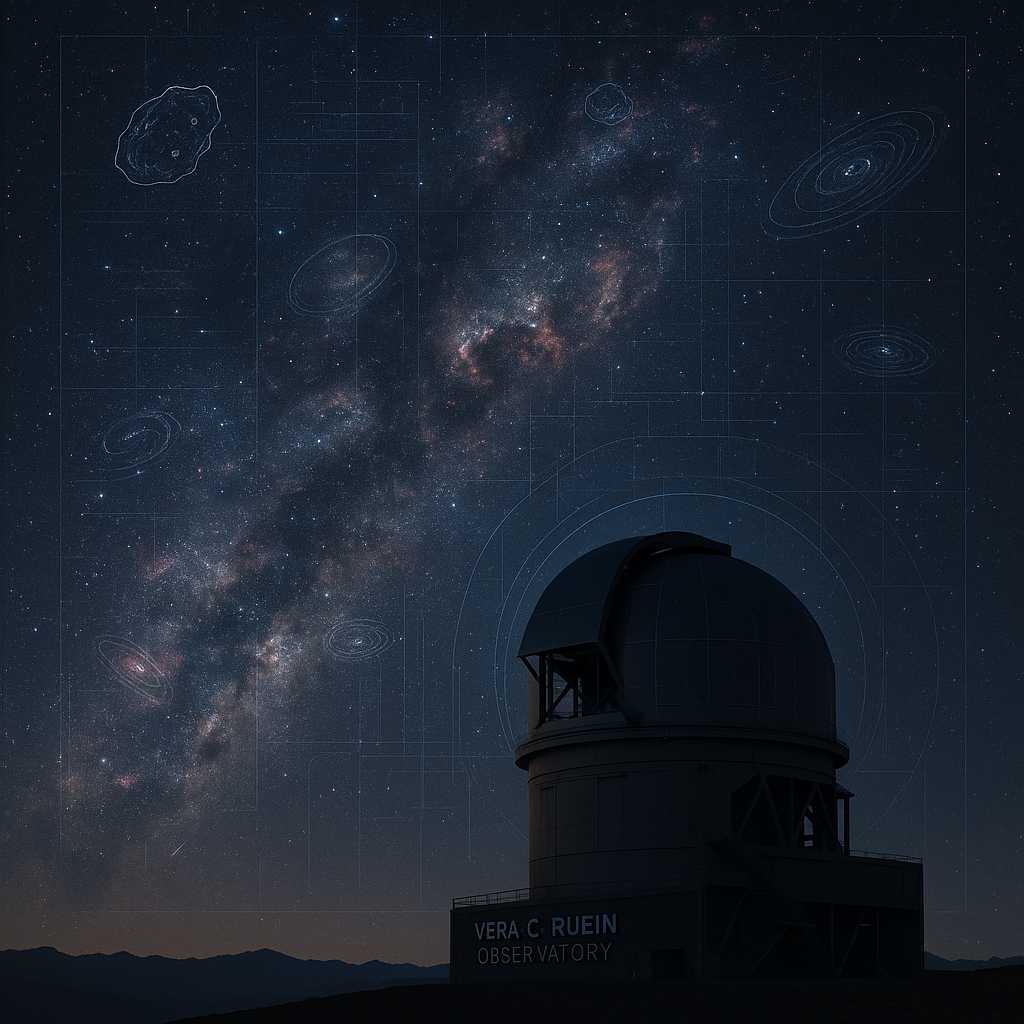
The night sky has always held a sense of wonder, but modern astronomy is about to delve into new depths thanks to the Vera C. Rubin Observatory, currently being completed in Chile. Named in honor of Vera Rubin, the pioneering astronomer whose work showed that most of the universe’s mass is made up of unseen dark matter, this state-of-the-art facility promises to revolutionize our understanding of the universe when it begins full operations.
The Observatory and Its Ambitious Mission
Situated on Cerro Pachón in northern Chile, the Rubin Observatory is home to the 8.4-meter Simonyi Survey Telescope, which will carry out the Legacy Survey of Space and Time (LSST). This ambitious ten-year project aims to create the most detailed digital map of the southern sky ever produced. Unlike traditional telescopes that focus on a narrow portion of the sky, Rubin’s wide-field camera—a 3.2-gigapixel behemoth, the largest ever built for astronomy—will capture a panorama covering nearly 10 square degrees of sky at a time.
Scientific Goals: From Dark Matter to the Dynamic Sky
The Rubin Observatory’s unprecedented observing power will allow astronomers to tackle four main science goals:
- Probing Dark Matter and Dark Energy: By mapping billions of galaxies and their distribution over time, LSST will refine measurements of the universe’s expansion and shed light on the nature of dark matter and dark energy.
- Cataloging the Solar System: The survey is expected to identify and track millions of asteroids and other small bodies, helping to understand both our solar system’s origins and protect Earth from potential hazardous objects.
- Exploring the Changing Sky: LSST’s fast cadence will enable rapid detection of transient phenomena—supernovae, variable stars, and other brief cosmic events—making it a powerful tool for time-domain astronomy.
- Mapping the Milky Way: By surveying our galaxy in unprecedented detail, the Rubin Observatory will chart its structure, history, and the fundamental processes of star formation.
A Technological Marvel
Behind the science lies remarkable engineering. The camera’s sensors can capture faint objects with great clarity, while data pipelines will process over 20 terabytes per night, making the LSST one of the largest public scientific datasets in existence. Researchers worldwide will have access to this data, enabling discoveries well beyond the Observatory’s original mission.
Looking Ahead
With its first light captured in 2024 and full operations targeted for 2025, the Rubin Observatory heralds a new age of discovery. Just as earlier astronomical surveys unlocked insights into the universe’s scale and structure, this observatory’s relentless watch on the southern sky will enable a deeper, dynamic understanding of our evolving cosmos.
As we stand on the threshold of this new era, the Vera Rubin Observatory embodies the spirit of its namesake—unwavering curiosity, rigorous science, and the drive to unravel the universe’s most profound mysteries.
— Darlene
Leave a Reply