
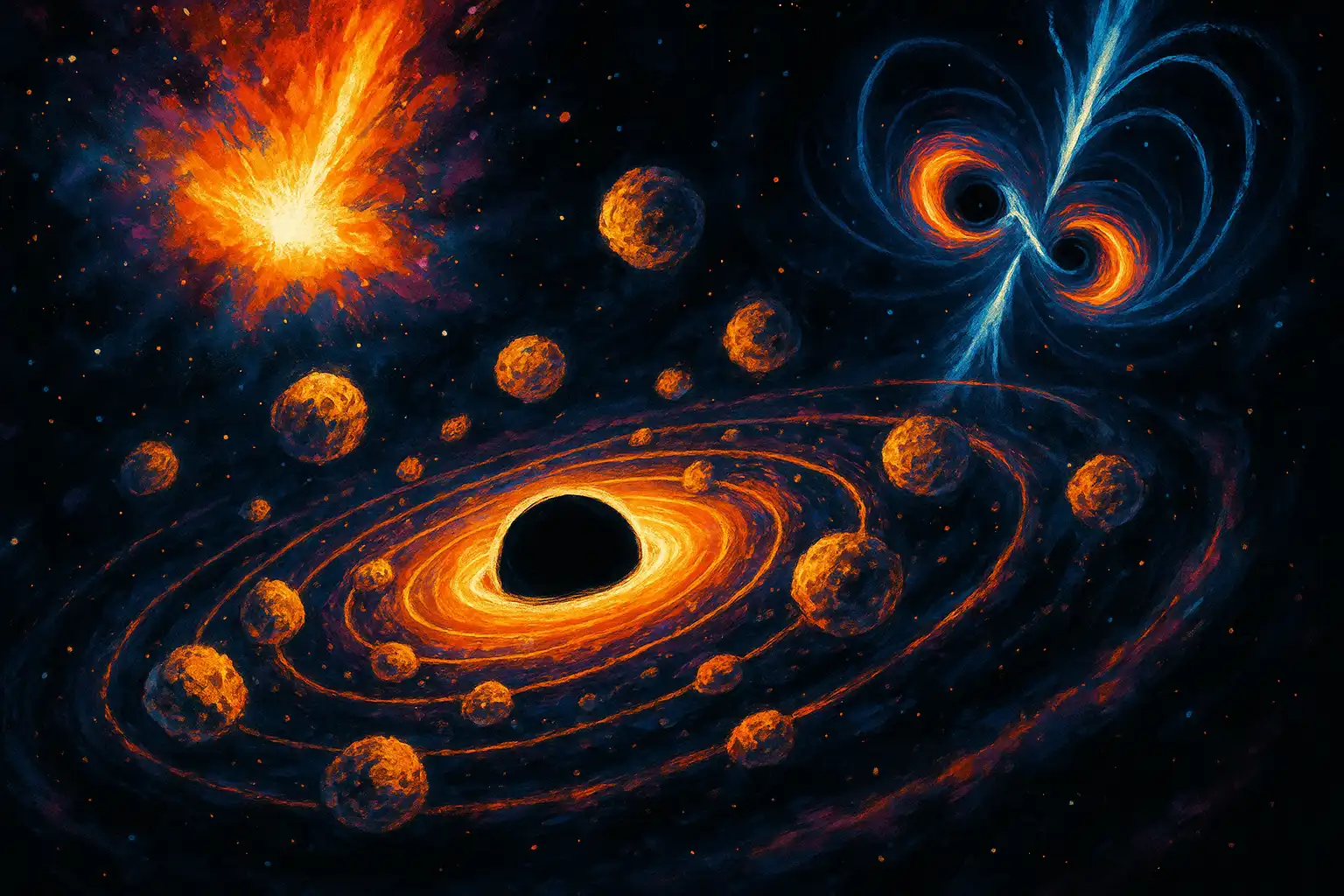
The universe is no stranger to surprises, but recent observations around black holes have led to a cascade of revelations upending assumptions even many experts once took for granted. From the heart of our own Milky Way to the depths of distant galaxies, astronomers are witnessing phenomena that both challenge and reinforce foundational theories. Let’s delve into these astonishing new findings.
Dusty Orbits at the Galaxy’s Core
For decades, conventional wisdom held that the supermassive black hole at the center of the Milky Way—Sagittarius A*—would inevitably consume or eject any star or dusty object that ventured too close. However, new research using the cutting-edge Enhanced Resolution Imager and Spectrograph (ERIS) at ESO’s Very Large Telescope in Chile has uncovered evidence that some mysterious “dusty objects” are actually maintaining remarkably stable orbits around Sagittarius A*. Instead of being destroyed, these objects are surviving—and perhaps even forming—in the black hole’s extreme environment. This discovery demonstrates that the dynamics at the galactic center are more complex than previously imagined, raising the possibility that the black hole might even encourage the formation of such objects, possibly through the merging of binary stars (Phys.org).
The Biggest Flare Ever Seen from a Distant Black Hole
Astronomers have recently documented the most powerful and distant flare of energy ever recorded from a supermassive black hole. This exceptional event, detected by the Zwicky Transient Facility at Palomar Observatory, involved a cosmic object (J2245+3743) that appeared unremarkable when first observed in 2018. However, by 2023, it became clear that the flare—a colossal outburst of energy from an active galactic nucleus (AGN)—was far brighter and longer-lasting than any previously recorded. Such extreme flares are extremely rare, occurring in roughly 1 in a million AGN. This event not only illuminates how black holes can shred and energize matter but also gives insights into the ways they influence their host galaxies (CNN, Caltech).
Black Hole Collisions: Magnetic Mysteries and Powerful Jets
Another remarkable advance comes from the study of black hole collisions. Recent simulations, which now factor in previously neglected magnetic effects, have yielded the first direct radio evidence of powerful, twisting jets emitted from two active, extremely massive black holes locked in a close encounter. Each black hole not only powers its own jet but also exhibits behavior affected by their proximity and combined magnetic fields. These findings open new avenues for understanding the role magnetic forces play during the most violent cosmic mergers (YouTube).
A Dynamic New Era of Black Hole Science
These discoveries challenge old certainties and reveal just how dynamic the universe truly is. Whether it’s stars and exotic objects defying destruction at the galactic center, far-off black holes launching history-making flares, or the hidden influence of magnetic fields in celestial collisions, black holes continue to astonish and educate us. The next generation of telescopes and instruments promises even more surprises—and perhaps deeper answers to the cosmic puzzles that keep astronomers looking up.

Leave a Reply