
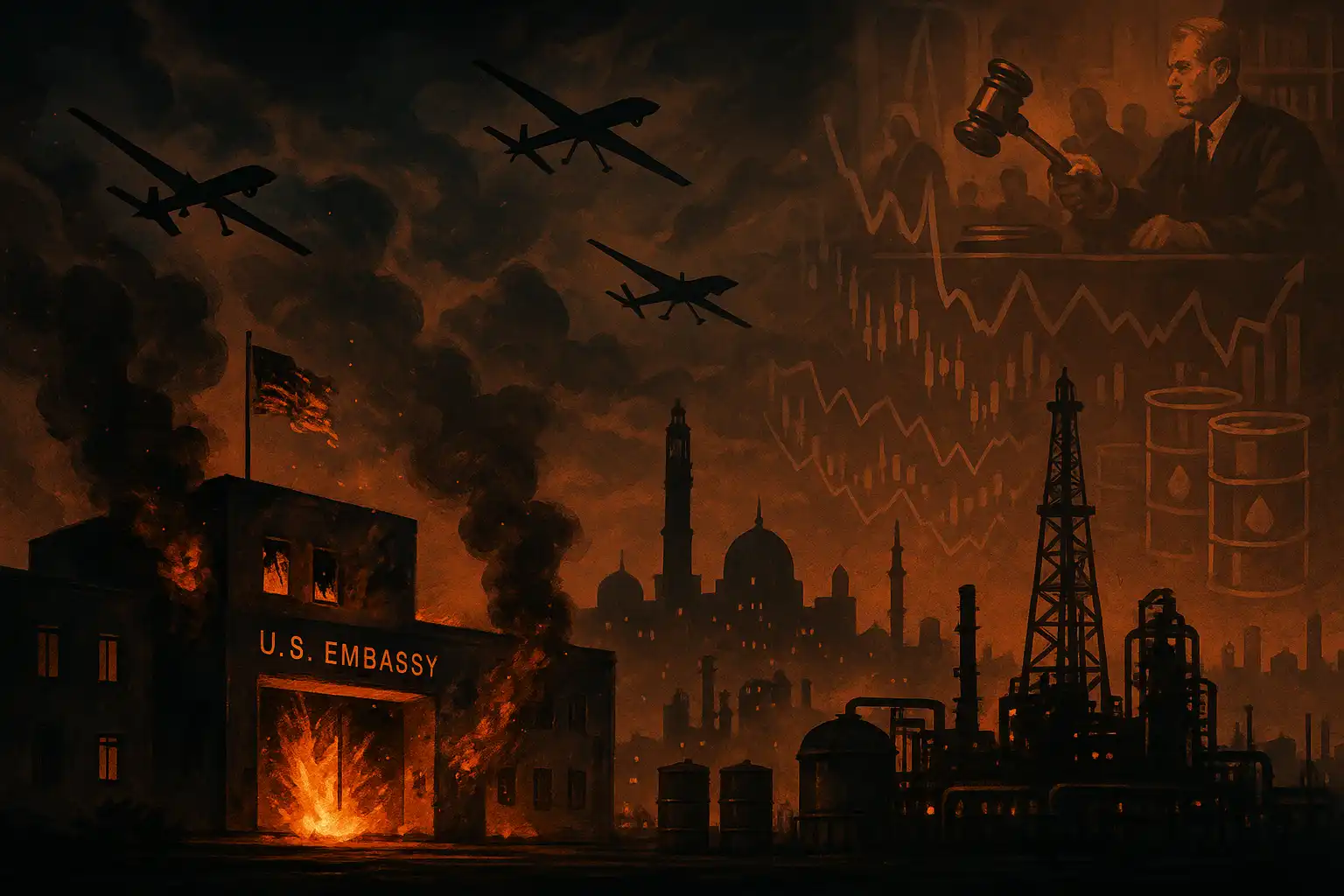
War with Iran entered Day 3 with a volatile mix of battlefield escalations, political crossfire, and market jitters. ABC’s Nightline devoted its latest broadcast to the widening campaign—dubbed Operation Epic Fury—flagging new details on coordinated U.S.–Israeli strikes, questions about the endgame, and an FBI probe into possible Iran ties in a deadly Texas bar rampage [1].
On the ground, ABC reported a drone strike that hit the U.S. Embassy site in Saudi Arabia, part of a rapid-fire sequence of developments that also included a rising American death toll and a White House push to justify the operation’s scope and aims [2]. The Washington Post’s live desk highlighted that four U.S. soldiers killed in the conflict have been identified and noted a separate strike that hit the U.S. Consulate in Dubai—signs that the fallout is radiating across the Gulf [3].
The conflict’s political aperture widened, too. CNBC carried a blistering critique from Sen. Tim Kaine, who argued President Trump “abandoned diplomacy” and that “our service members are dying as a result.” The network also aired a segment with Secretary Rubio pledging U.S. action to blunt an oil price spike, underscoring the administration’s bid to contain economic blowback even as the president delivered his own situation updates from the White House [4]. ABC’s special coverage, meanwhile, noted the president has offered multiple rationales for the strikes as the operation broadens [2].
All of this unfolds in the shadow of a historic leadership transition in Tehran. The Washington Post reported the death of Iran’s supreme leader, Ayatollah Ali Khamenei, at 86—an event reverberating through Iran and its diaspora [3]. ABC’s Nightline captured the mix of hope and unease among Iranian Americans now watching the conflict and its consequences in real time [1].
Markets are scanning the horizon for worst‑case scenarios. With oil already twitchy on supply‑route risk, CNBC’s programming emphasized the policy levers under discussion to keep prices in check, even as corporate leaders preach near‑term focus amid uncertainty [4]. Any sustained disruption to Gulf energy infrastructure—or to shipping lanes—would likely test those levers quickly.
In the U.S., a landmark court decision landed in Georgia: a father was found guilty of murder in connection with a school shooting case and now faces up to 100 years in prison, ABC reported [2]. The Washington Post identified the defendant as Colin Gray, father of the accused shooter, underscoring a growing legal push to hold relatives accountable when firearms access and negligence are alleged [3].
What to watch next
- Escalation risks: Further proxy or direct strikes on U.S. or allied diplomatic sites would raise the stakes—and insurance costs—for operations across the Gulf [2] [3].
- Energy shock absorbers: Measure the gap between Secretary Rubio’s promised steps and market reality if shipping or production takes a deeper hit [4].
- Domestic security lens: The FBI’s scrutiny of possible Iran links in the Texas bar attack shows how quickly overseas conflicts can refract through U.S. law‑enforcement priorities [1].
The through‑line is sobering: a regional war edging outward, a White House attempting to narrate and justify a fast‑moving campaign, and a U.S. public processing the human, economic, and legal ripples at home and abroad.
References
- Nightline Full Broadcast — Monday, March 2, 2026 (Modern Ghana) [Link]
- ABC News video hub featuring ‘US Embassy in Saudi Arabia hit by Iranian drones,’ ‘American death toll rises in Operation Epic Fury,’ and related coverage [Link]
- Editorial Roundup: United States (The Washington Post roundup page highlighting Khamenei’s death and live updates on the Iran conflict) [Link]
- Market Open: March 3, 2026 (CNBC) [Link]

Leave a Reply