
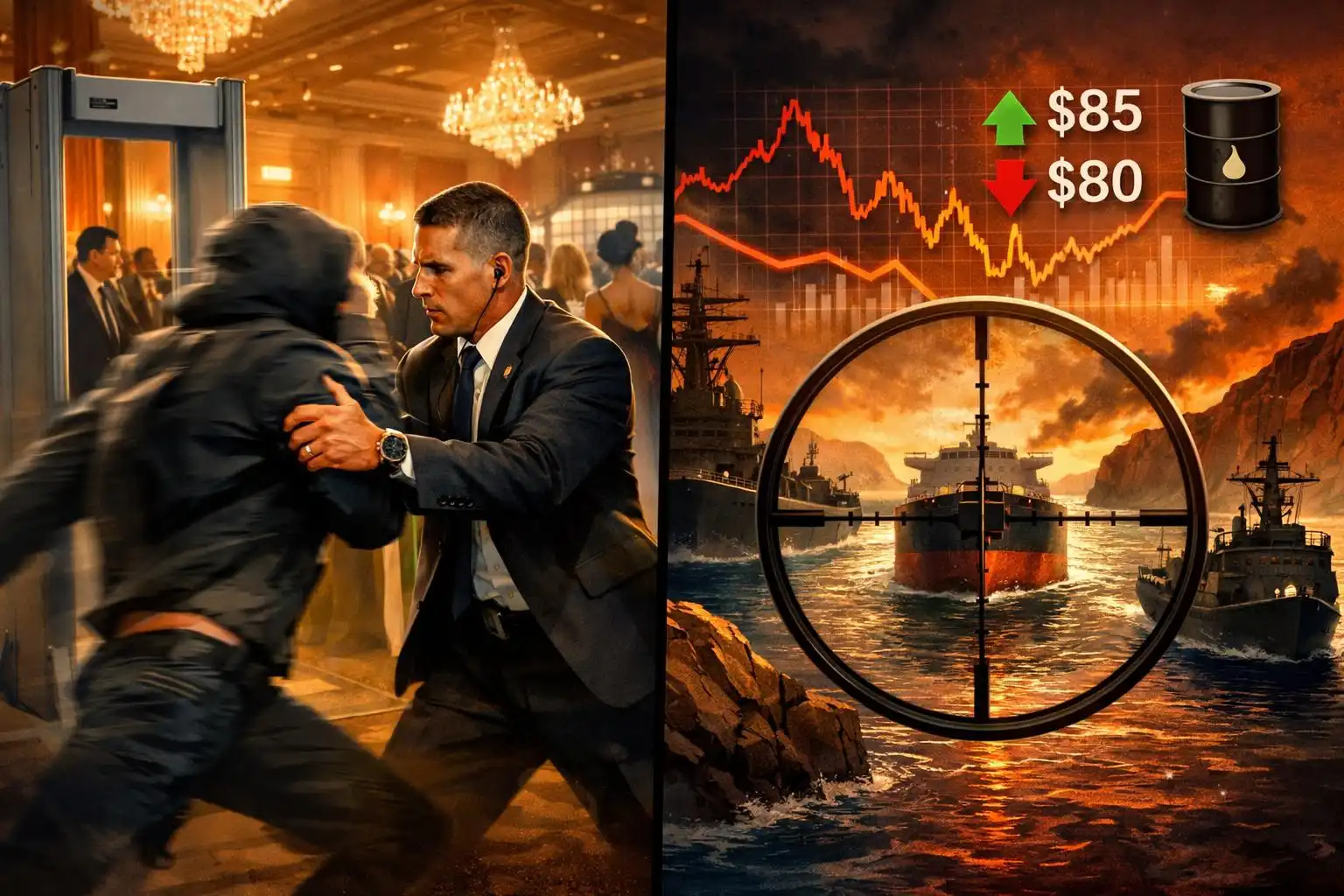

Two storylines defined the weekend: a jarring security lapse at Washington’s media‑politics gala and fresh warnings that the Strait of Hormuz remains the world’s most dangerous economic choke point.
White House Correspondents’ Dinner scare

- Video from inside the Washington Hilton shows the suspected gunman breaching security at the White House Correspondents’ Dinner, sprinting through a metal detector and toward the ballroom where the president was seated [2].
- D.C. officials said a suspect is in custody following a shooting incident near the event and held a late‑night briefing to update the public [3].
- Trump said there was no advance warning of threats before the incident, a point likely to fuel questions about the protective posture around a high‑risk, high‑profile venue [4].
Why it matters: The dinner is a magnet for current and former officials, media leaders, and celebrities. A successful breach—even if quickly contained—will sharpen scrutiny of magnetometer lines, perimeter control, and interagency coordination at special events.
Hormuz, energy shock risk, and markets
- The International Energy Agency’s chief warned the deepening Hormuz crisis poses the “biggest energy security threat in history,” with the situation “getting worse every day,” as investors toggle between ceasefire headlines and supply‑shock fears [1].
- Markets have seesawed alongside diplomacy: stocks slid when U.S.–Iran tensions resumed and the Strait of Hormuz was effectively shuttered, then futures bounced after Trump extended a ceasefire window [1].
- Pump pain may linger: Gasoline could remain at $3 a gallon or more into next year, according to remarks cited by Yahoo Finance, underscoring how chokepoint risk and refinery dynamics are filtering to consumers [1].
- Notably, the AI trade has so far shown resilience even as war jitters ripple through energy and cyclicals, a split that continues to define 2026’s market tape [1].
The big picture
- Security: Expect an after‑action review of the WHCD security plan and potential adjustments to magnetometer placement, soft‑target buffer zones, and real‑time threat routing.
- Energy and markets: As long as Hormuz remains constrained and talks oscillate, price volatility will be the rule—particularly in crude, refined products, and transport. Equity leadership may keep bifurcating between AI‑adjacent winners and companies exposed to input‑cost spikes.
What’s next
- WHCD incident: Look for updated timelines from D.C. officials and the Secret Service on the breach sequence and custody status, plus any venue‑level changes ahead of the next D.C. marquee events [3].
- Hormuz watch: Traders will key off concrete evidence of sustained shipping flows through the strait, any extension or slippage in the ceasefire window, and IEA/OPEC guidance on contingency barrels and demand.

Leave a Reply