
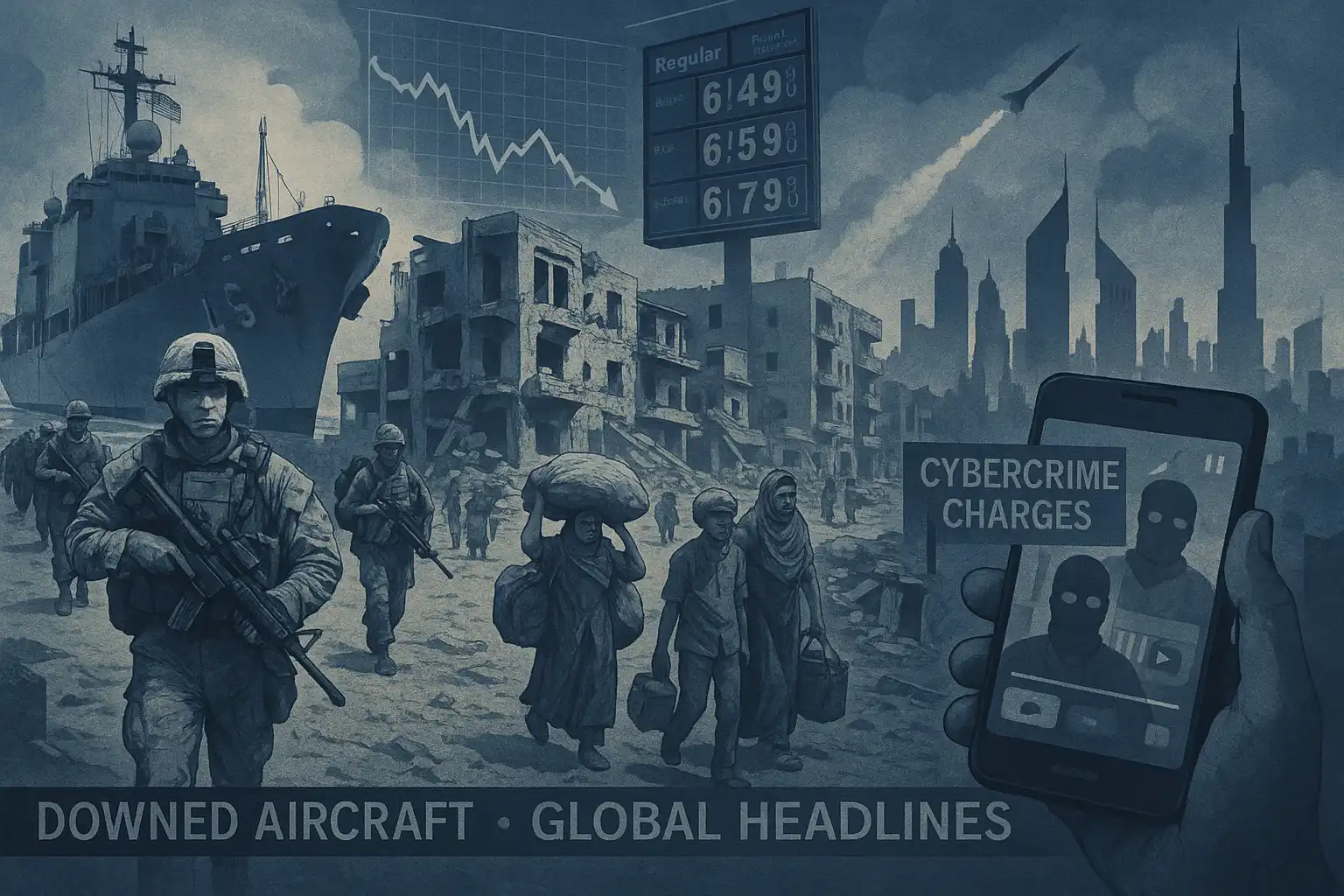
The Middle East’s war footing tightened overnight and rippled through U.S. security and markets. Washington ordered a 2,200‑strong Marine unit and three warships to the region, even as a Lebanese official signaled, “We are ready” to negotiate with Israel. The UN now estimates more than 800,000 people have been displaced in Lebanon amid Israel’s expanding operations [1].
Tragedy struck in western Iraq, where a U.S. KC‑135 refueling aircraft went down, killing six service members, the Pentagon confirmed [1]. At home, a federal judge blocked Justice Department subpoenas involving Federal Reserve Chair Jerome Powell—an unusual legal flashpoint at the intersection of monetary policy and oversight [1]. In the U.S., the Jewish community responded to the Michigan synagogue attack as a former DHS official warned about rising domestic threats [1].

Gas prices are re‑accelerating and hitting wallets. “Nothing erodes household liquidity faster than higher gas prices,” economist Joe Lavorgna said, underscoring how energy shocks from the region are squeezing consumers [2]. The macro backdrop is softening: fourth‑quarter U.S. GDP was revised down to 0.7% growth, while January core inflation registered 3.1%—an uncomfortable mix for policymakers and markets [2].
Corporate tape: Adobe shares slid after earnings as longtime CEO Shantanu Narayen said he will step down, a changing‑of‑the‑guard moment for a software bellwether [2]. Labor signals are flashing, too: ServiceNow’s Bill McDermott warned unemployment could “reach the mid‑30s” for new college graduates, spotlighting a rough near‑term outlook for young job seekers [3]. And U.S. Trade Representative Jamieson Greer discussed the administration’s tariff agenda and the Iran war’s knock‑on effects within the broader U.S.–China trade relationship—issues markets are parsing closely [2].
Beyond the battlefield, the war’s digital front produced fresh consequences: Dubai authorities charged 20 people—including a 60‑year‑old British tourist—under cybercrime laws over videos related to an Iranian missile strike on the city. The British Embassy warned nationals that reposting sensitive conflict content can lead to prison, fines, and deportation in the UAE [4].
Other headlines to watch: Cuba’s president confirmed talks with the U.S., signaling a tentative thaw after years of tension [1]. In the consumer arena, internal messages showed Live Nation employees mocked ticket buyers, adding fuel to ongoing scrutiny of the live‑events giant, while a separate lawsuit alleged a protein‑bar maker misled customers [1].
Bottom line: A widening conflict and humanitarian strain in Lebanon, a fresh U.S. deployment, and a fatal air crash are reshaping the security picture just as growth cools and energy costs bite. Markets now face a familiar but fraught equation: softer output, sticky inflation, and geopolitical risk—all while policy choices on trade and tariffs remain in play [1] [2] [3].
References
- ABC News video roundup: Multiple March 13, 2026 segments (Middle East updates; DOJ–Powell subpoenas; KC‑135 crash; gas prices; Live Nation; Cuba talks)
- CNBC – Market Open: GDP revised to 0.7%, core inflation 3.1%; gas prices and household liquidity; Adobe CEO transition; USTR Greer on trade/tariffs
- CNBC – Late Morning Rundown: Labor outlook for grads; inflation/GDP context; energy headwinds
- Newser – UK Tourist Among 20 Charged in Dubai Over Missile Videos

Leave a Reply to Fact-Check (via Claude claude-sonnet-4-5-20250929) Cancel reply