
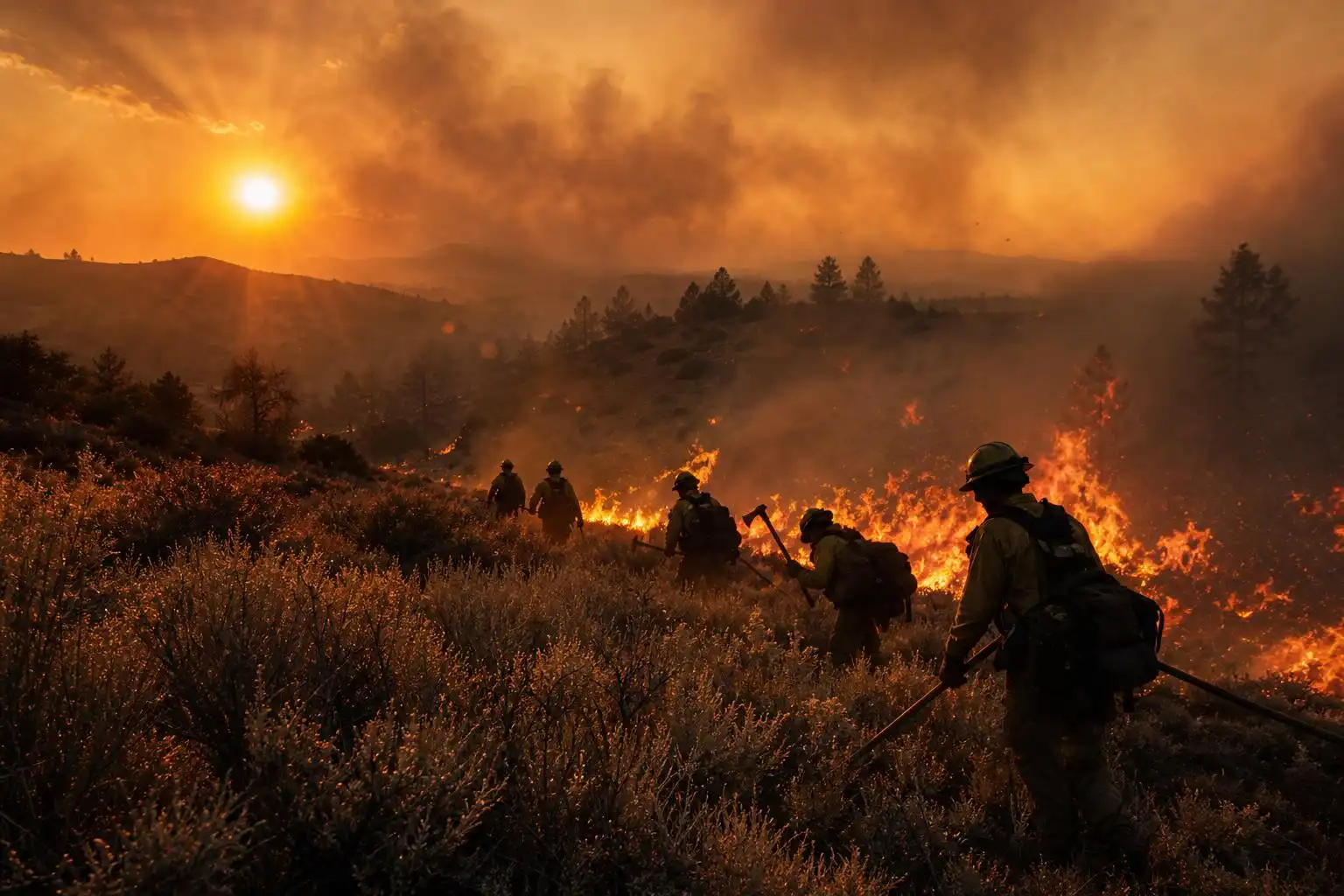

The western United States is entering one of those dangerous summer patterns where several hazards stack on top of each other: excessive heat, drought-cured vegetation, low humidity, gusty winds, and communities pushed to the edge of evacuation maps. Over the weekend, a Utah wildfire forced evacuations in a small town as much of the West—from the Rockies to the Pacific Coast—baked under above-average temperatures, with even hotter conditions expected in parts of the Southwest early in the week [1].
As a meteorologist, what stands out is not just the heat itself, but the timing and layering of risk. Much of Utah is already in severe to extreme drought, while parts of Arizona and Colorado are also dealing with severe drought. That matters because drought does not simply make landscapes look dry—it changes the fire behavior baseline. Fuels ignite more easily, fires spread faster, and crews have less margin when winds increase or humidity crashes [1].
Heat, drought, and wind are building a volatile fire environment
Red-flag warnings in southwestern Colorado underscored the classic wildfire recipe: gusty winds plus low relative humidity. In Arizona, a wildfire near Sedona burned hundreds of acres in steep, rugged terrain near Oak Creek Canyon and remained uncontained as evacuated residents waited to return home [1]. Terrain like that can complicate firefighting quickly. Slopes can accelerate flame spread, canyon winds can shift unexpectedly, and aircraft may be limited by visibility, turbulence, or smoke columns.
The heat risk is not limited to fire behavior. Extreme heat claimed the lives of three hikers in two separate incidents in the Grand Canyon last week, while temperatures in parts of the Southwest were forecast to climb toward dangerous levels, including up to 108°F in Carlsbad, New Mexico [1]. This is the human side of the weather map: a forecast high temperature becomes a search-and-rescue call, an evacuation order, or a family waiting for word from someone on a trail.
Even Florida saw a reminder that fire danger is not only a western problem. A brush fire in Miami-Dade County spread across roughly 2,000 acres on Saturday [1]. In humid climates, fire windows can still open when dry spells, wind, and available fuels overlap.
El Niño is now part of the background pattern
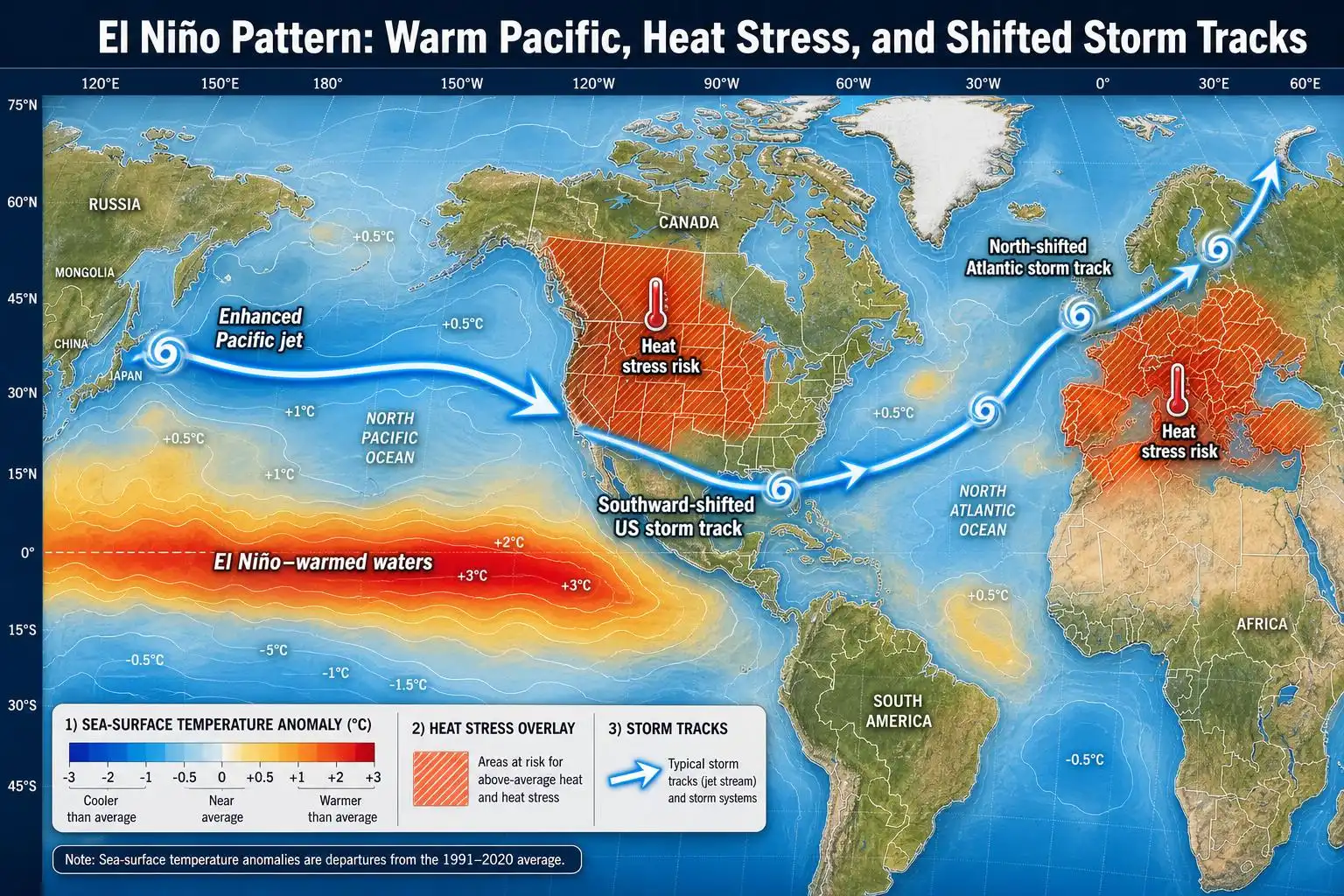
At the same time, the Pacific is shifting into El Niño. NOAA announced on June 11 that El Niño had begun, and forecasters expect it to intensify through the year [3]. One reported outlook gives the event a 63% chance of reaching the “very strong” threshold during the winter of 2026–27, which would place it among the strongest El Niño events in the modern record [2].
El Niño is a natural ocean-atmosphere pattern centered in the tropical Pacific, marked by warmer-than-average sea surface temperatures and changes in trade winds. But its reach is global. It can shift storm tracks, alter hurricane activity, reshape winter precipitation, and raise global average temperatures. During El Niño, the southern United States often trends wetter by autumn and winter. That can bring drought relief to some areas, especially parts of the Southeast—but it can also increase flood risk when repeated storm systems train over saturated ground [3].
It is important not to oversimplify this. El Niño does not “cause” every wildfire, heat wave, flood, or hurricane. Weather events form from local ingredients. But a strong El Niño can tilt the odds, and in a warmer climate, the atmosphere is already carrying extra heat and moisture. That means some hazards can become more intense when the pattern lines up.
A warming climate is amplifying heat stress
The broader heat signal is becoming harder to miss. A new study published in Nature Climate Change found that extreme “feels-like” temperatures, heat stress days, and tropical nights have become more frequent, longer-lasting, and more severe over the past six decades [5]. Some countries, including Mexico, Kenya, and Italy, are now experiencing one to two additional months of heat stress compared with several decades ago [5].
That matters because heat stress is about more than the number on a thermometer. Humidity, nighttime temperatures, wind, sun angle, and physical activity all influence how hard the body has to work to stay cool. When nights stay warm, people without reliable cooling get less recovery time. For outdoor workers, older adults, people with chronic illness, and those experiencing homelessness, a longer heat season can be life-threatening.
In the United States, the same research found that much of the country now sees at least 15 more days of strong heat stress, while southern areas including Texas and Florida are seeing close to 25 or more days with very strong heat stress [5]. Those numbers line up with what emergency managers and public health officials have been seeing on the ground: heat is no longer a short midsummer inconvenience. It is a longer season of cumulative strain.
Europe’s heat is another warning sign
Across the Atlantic, scientists with World Weather Attribution examined a European heat wave that began June 18 and concluded that climate change was the driving force behind the extreme heat [4]. Their rapid analysis found that 45% of 850 cities studied across 30 European countries had broken, or were expected to hit, records for heat stress—a combined measure of heat and humidity [4].
That European pattern is relevant for U.S. readers because heat waves are not isolated curiosities anymore. They are increasingly part of a global pattern of higher baseline temperatures. When a heat dome forms over Europe, the U.S. Southwest, Mexico, or southern Asia, it now forms in an atmosphere that is warmer than it used to be. That raises the ceiling for extremes and increases the odds that records will fall.
What communities should watch next
For the western U.S., the immediate concerns are straightforward: fire starts, evacuation readiness, heat illness, and smoke exposure. The most dangerous days often arrive when wind and low humidity overlap with peak heat. Residents in fire-prone areas should know their evacuation zones, keep vehicles fueled or charged, prepare go-bags, and sign up for local emergency alerts. If officials issue an evacuation order, leaving early is safer than waiting until roads are crowded or visibility drops.
For heat, the best advice is simple but serious: avoid strenuous activity during the hottest part of the day, drink water before you feel thirsty, check on neighbors, and never underestimate the danger of hot trails or exposed desert landscapes. In places like the Grand Canyon, temperatures can be dramatically hotter below the rim than at the trailhead. A hike that feels manageable at sunrise can become dangerous by midday.
Looking toward fall and winter, the strengthening El Niño deserves close attention. The southern tier of the U.S. may eventually trade drought and fire concerns for heavy rain and flooding potential. That does not mean every location will be wet, or that drought will vanish. But it does mean flood planning, reservoir management, stormwater systems, and early-warning communication will be just as important as fire preparation.
The common thread is preparedness. A hotter climate does not remove natural variability—it loads it. El Niño will still ebb and flow. Heat waves will still depend on weather patterns. Fires will still need ignition sources and fuels. But the background conditions are changing, and that means communities need forecasts, public health planning, resilient infrastructure, and clear communication more than ever.
References
- Utah wildfire forces evacuation of small town as extreme heat roasts US west – The Guardian
- A super El Niño threatens disaster. Trump is handling it recklessly | Terry Garcia – The Guardian
- The risk of a ‘super’ El Niño is rising. Here’s what it means for North America – BBC
- Europe’s extreme heat would be impossible without climate change, scientists say – AP News
- Mexico, Italy and others see up to two more months of heat stress than in the 1970s, study says – AP News

Leave a Reply
You must be logged in to post a comment.