
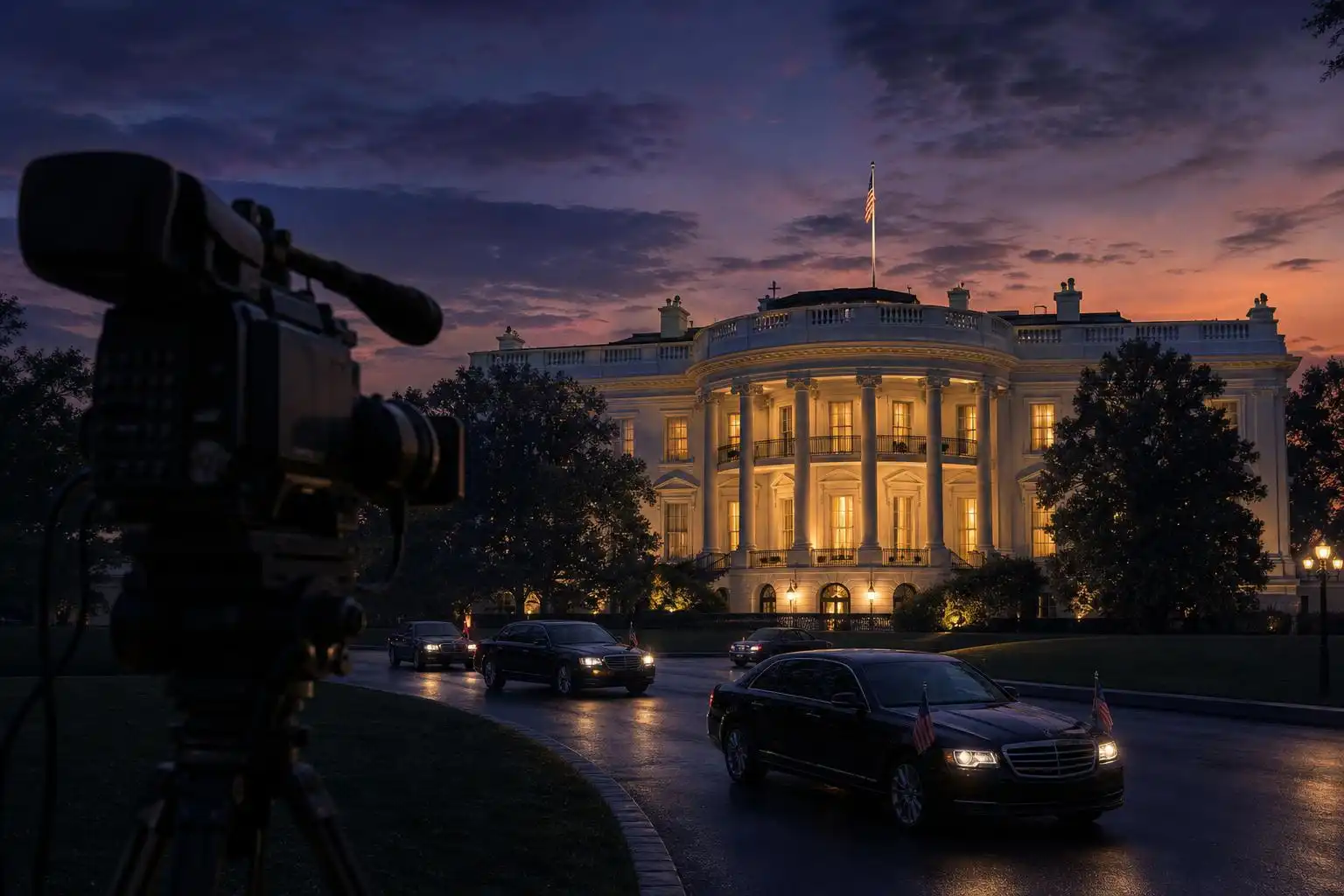

A proposed pause in the Iran war, a high-stakes visit by China’s leader and a fight over press access to the White House are driving Friday’s news. Each story turns on the same question: whether a public announcement will produce a change on the ground.
Iran puts a seven-day plan on the table
Iran has proposed a seven-day plan to end the war that would reopen the Strait of Hormuz and revive nuclear talks. It is an offer, not an agreed ceasefire, and the reporting does not establish that Washington has accepted it.[2]

The proposal arrives as the conflict’s reach grows. Saudi authorities said an Iran-backed militia in Yemen fired six ballistic missiles at cities deep inside the kingdom.[3] France plans to send soldiers to Saudi Arabia to help secure energy sites after attacks on Red Sea cities added pressure to global oil supplies.[2]
For now, the test of Tehran’s proposal is practical: whether the parties can agree on a halt to attacks and a dependable route for ships through Hormuz. A proposed reopening cannot relieve supply fears by itself.
Xi’s Washington visit meets a press-access fight
President Xi Jinping’s state visit brought him to the White House on Thursday for talks with President Trump as the two governments wrestled with tariffs, trade and potential artificial-intelligence regulation. The visit is Xi’s first to Washington in roughly a decade, but the supplied reporting does not point to a settled trade agreement.[2]
The summit has also become the backdrop to a domestic confrontation. A federal court ordered Trump to reverse a White House ban affecting CNN, MS NOW and Politico. The New York Times reported that the order came around 1 a.m. Thursday, yet none of the affected outlets were granted entry later that morning.[1][3]
That leaves the immediate issue unresolved in the available reporting: a court order had been issued, but access had not been restored by Thursday morning. The contrast was especially visible during a visit by Xi, whose government sharply restricts independent media.[2]
U.N. speeches expose another diplomatic divide
At the United Nations, Israeli Prime Minister Benjamin Netanyahu denounced his country’s critics as “moral cowards.” Palestinian leader Mahmoud Abbas addressed the General Assembly by prerecorded video after the United States denied him a visa.[2][5]
The speeches put the region’s political divisions on display, even as the Iran proposal raises the possibility of a separate diplomatic opening. Neither address, as reported here, establishes a new agreement.
Other developments to watch
Michigan’s governor has ordered an inquiry after an immigration-enforcement pursuit in Grand Rapids ended in a fatal crash involving a Guatemalan immigrant.[1] Forecasters are also tracking a powerful East Coast storm for the weekend, while cautioning that its precise path remains uncertain.[1]
In Ethiopia, the army says it killed 272 Tigrayan fighters in Amhara, while the Tigray People’s Liberation Front describes the situation as full-blown war. The reported casualty figure is the army’s claim; the competing statements underscore the danger of further escalation.[5]
References
- Today’s Headlines: Judge Blocks Trump’s White House Ban on CNN, MS NOW and Politico — https://messaging-custom-newsletters.nytimes.com/dynamic/render?uri=nyt%3A%2F%2Fnewsletter%2F256597ea-11fd-5252-adab-889ada8ab017&productCode=TH&isViewInBrowser=true
- Today’s Headlines: In Trump’s White House, China’s Dictator … — https://messaging-custom-newsletters.nytimes.com/dynamic/render?uri=nyt%3A%2F%2Fnewsletter%2Fa2ed8758-ef26-57bc-8b6d-1cea489c9ca7&productCode=TH&isViewInBrowser=true
- Breaking News, US News, World News and Videos — http://www.nytimes.com/glogin?URI=http%3A%2F%2Fwww.nytimes.com%2F2007%2F05%2F01%2Fworld%2FUN%2FGA.html&OQ=_rQ3D1Q26hp&OP=1cc5693dQ2F2pcM2Q5B%21Q5C5X%21%21Q26h2hSS12SQ3A2Q7ES2p%21XaQ5B2Q3EQ3BQ5BQ5Bacc%2C5Q262Q7EQ7EQ3BX%2CQ20Q24mQ26Q3Ea
- News | Today’s latest from Al Jazeera — https://www.aljazeera.com/news


Leave a Reply