
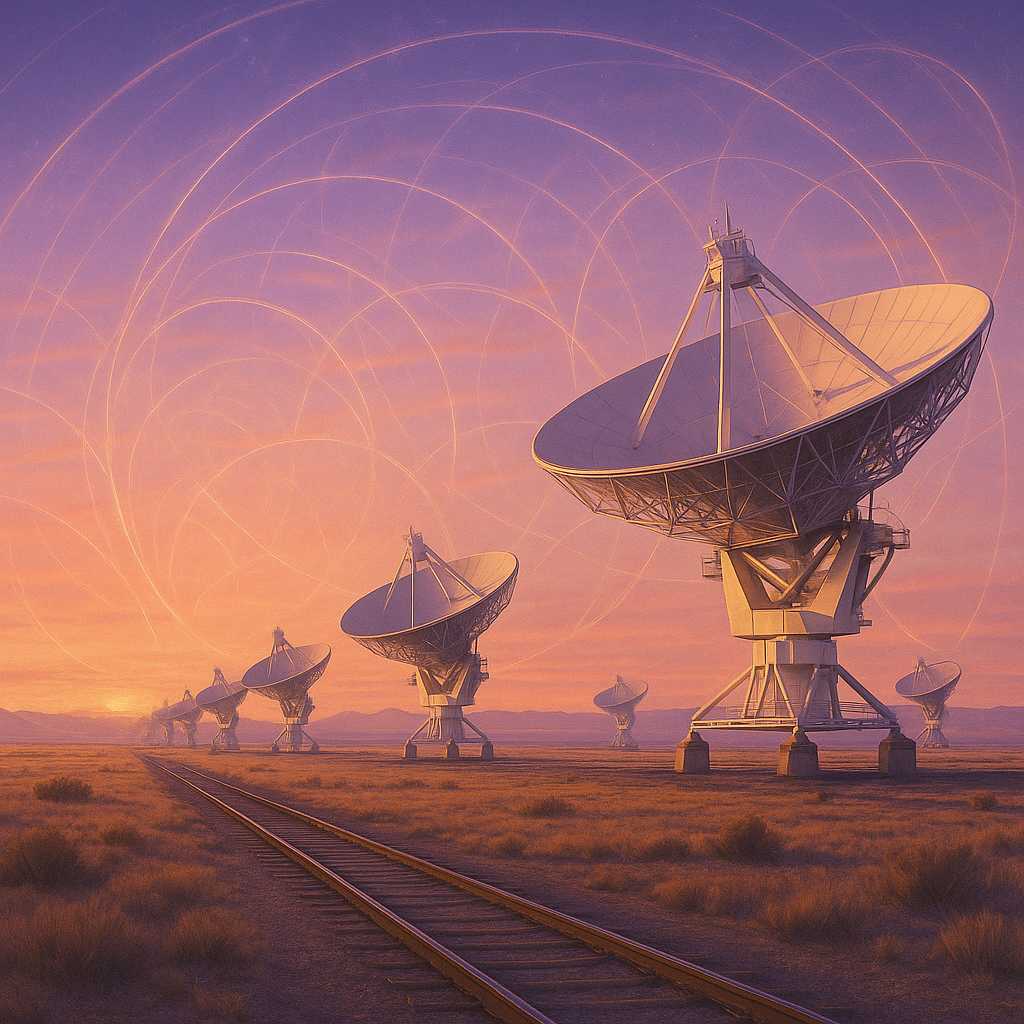

When most people think of astronomy, they imagine gleaming optical telescopes pointed skyward, catching the faint glimmer of distant stars. Yet much of our universe is invisible to the human eye. To truly explore the cosmos, astronomers have harnessed the power of radio waves—an endeavor in which the Very Large Array (VLA) has played a leading role for decades.
Situated on the plains of San Agustin, New Mexico, the VLA is one of the world’s premier radio observatories. Completed in 1980 and operated by the National Radio Astronomy Observatory (NRAO), its 27 iconic white dishes are spread across a Y-shaped track stretching up to 36 kilometers. Each dish measures 25 meters (82 feet) in diameter, working in concert as an interferometer to achieve far greater resolution than any single antenna could provide.
The VLA has revolutionized our understanding of phenomena like pulsars, quasars, black holes, and the giant jets emitted by active galaxies. Groundbreaking discoveries have included fine details of the Milky Way’s spiral arms, the detection of water masers in star-forming regions, and imagery revealing supernova remnants in striking detail. Its flexibility—antennas can be moved to change the array’s resolution—makes it invaluable for a wide range of astronomical investigations.
One of the VLA’s most publicized moments came in the late 1980s, when it featured in the movie “Contact.” But its real-life contributions to science far outweigh its silver-screen cameos. It continues to play a leading role in modern astronomy, supported by upgrades that keep it on the forefront of technology.
From revealing hidden structures in galaxies to tracking the afterglows of cosmic explosions, the VLA exemplifies how listening, as well as looking, has expanded humanity’s cosmic horizons. As we move further into the era of multi-messenger astronomy, the legacy and continued impact of the VLA remain bright—if invisible to the naked eye.
Leave a Reply
You must be logged in to post a comment.