
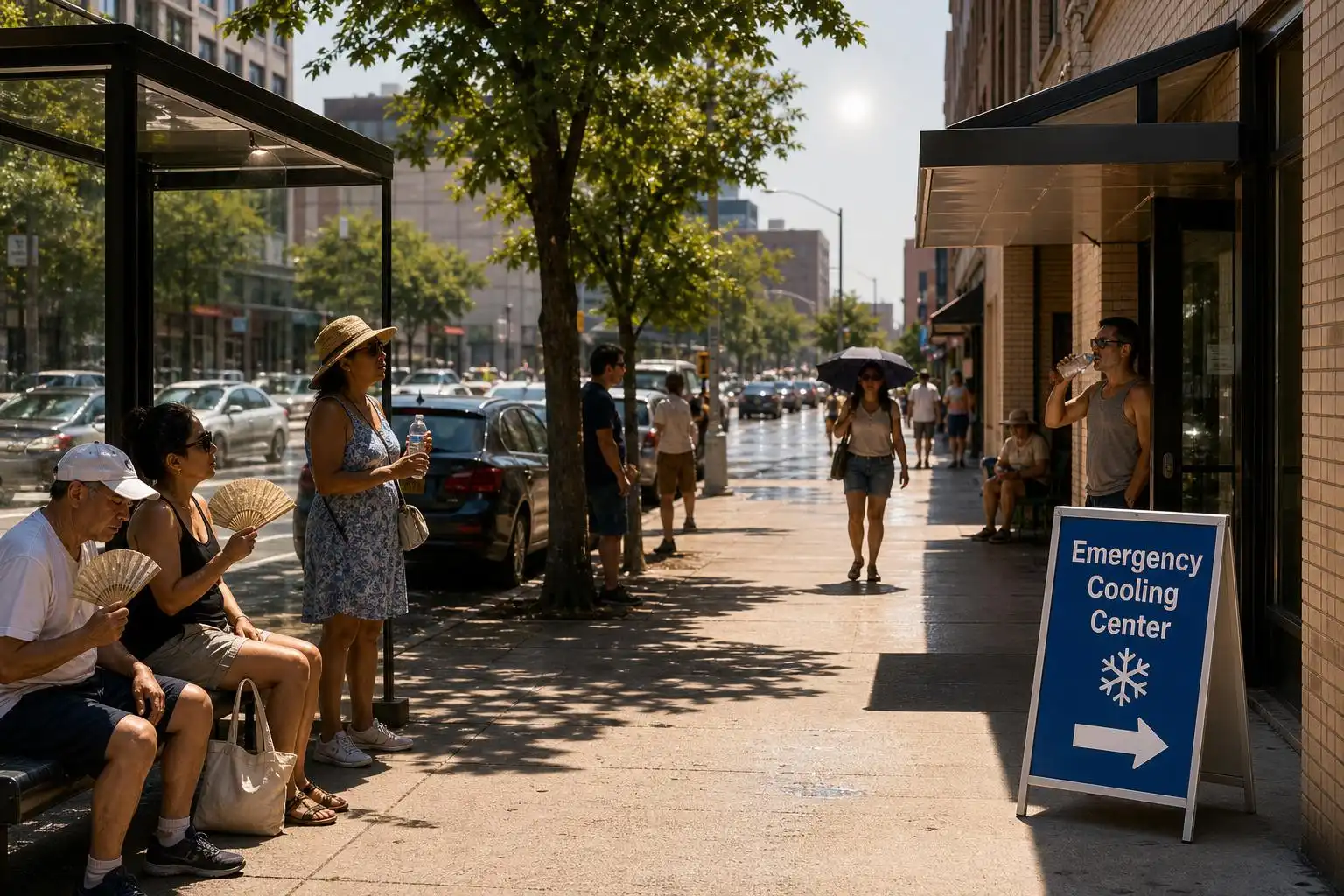

The most dangerous weather disaster in America this holiday week has not been a tornado outbreak or a landfalling hurricane. It has been heat—persistent, humid, and in many places nearly inescapable.
At least 25 people have died as a record-setting heat wave spread across large portions of the United States, with more than 20 states reporting temperatures above 100°F and more than 140 million people under active heat alerts as of Sunday, according to recent reporting on National Weather Service conditions and local death investigations.[1] In New Jersey alone, officials were investigating 19 suspected heat-related deaths as the worst of the heat began giving way to thunderstorms.[4]
That is the harsh truth about heat waves: they often kill quietly. There is no dramatic funnel cloud on the horizon, no storm surge pushing through a neighborhood, no radar signature that makes people run to shelter. Heat works through the body hour by hour, especially when nighttime temperatures stay high and humidity prevents sweat from cooling the skin.
A heat dome with dangerous staying power
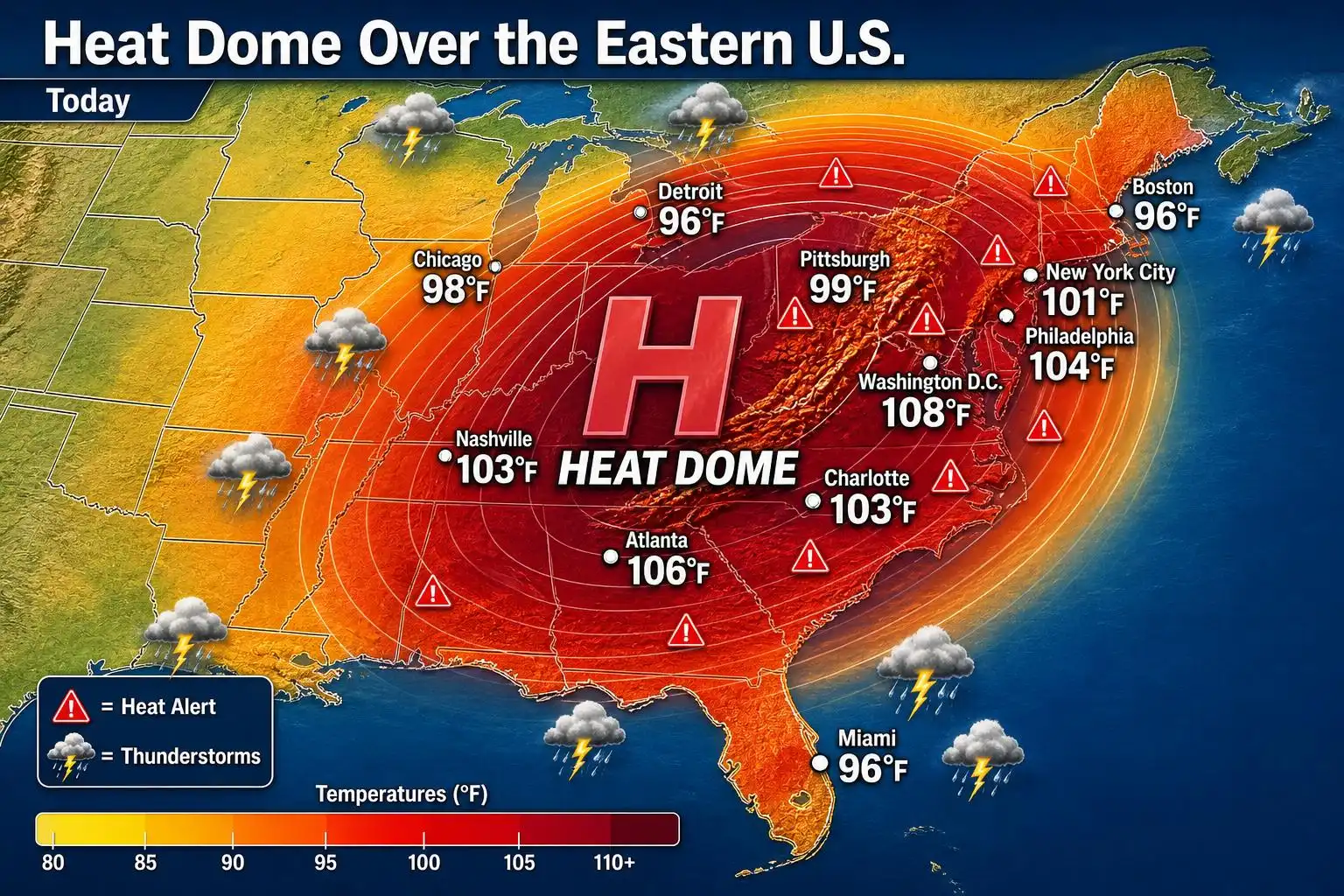
Meteorologically, this event has the signature of a strong summer heat dome—a broad area of high pressure that suppresses cloud development, limits rainfall, and allows hot air to build and recycle near the ground. Under a heat dome, sinking air warms as it compresses. Sunshine bakes pavement, rooftops, and fields. In cities, concrete and asphalt store that heat and release it slowly overnight.
That last piece matters. The Associated Press reported that the National Weather Service expected more than 90 local temperature records to be tied or broken through Wednesday, with roughly two-thirds of those records involving overnight heat.[2] From a human-health standpoint, record warm nights can be just as concerning as triple-digit afternoons because the body loses its recovery window.
When the low temperature only falls into the upper 70s or 80s, apartments without air conditioning remain hot, outdoor workers start the next day already stressed, and people with heart or kidney disease may not get enough relief for their bodies to reset. As meteorologist Bob Henson put it, “Nights can be just as dangerous as days,” warning that heat can kill as easily as a tornado or hurricane, only in a quieter way.[2]
The holiday weekend became a public-safety test
The timing made this heat wave especially difficult. It arrived during the July Fourth holiday period and the country’s semiquincentennial celebrations, when millions of people were expected to attend parades, fairs, concerts, fireworks displays, and outdoor sporting events.
In Washington, D.C., organizers canceled the Independence Day parade after the National Weather Service issued an extreme heat warning, with temperatures expected to soar in the capital and across the East Coast.[5] The Great American State Fair on the National Mall also temporarily closed after 44 visitors were treated for heat-related illness; 11 people were taken to the hospital, and seven of those cases were considered serious.[5]
Then came another classic summer hazard: thunderstorms. Thousands of people gathered on the National Mall for President Donald Trump’s planned July Fourth-related speech and fireworks event were told to evacuate as darkening skies and the threat of thunderstorms moved in.[3] That sequence—dangerous heat during the day, then thunderstorm risk later—is common in stagnant summer air masses. Heat and humidity can load the atmosphere with instability, and when a boundary or disturbance arrives, storms can develop quickly.
For emergency managers, this kind of compound risk is a nightmare. People may already be dehydrated or fatigued from heat when lightning, gusty winds, or heavy rain forces them to move. Crowds become harder to manage. Medical calls can spike. Communication becomes critical.
Why this heat is so hard on the body
The human body is remarkably good at maintaining a stable internal temperature, but only up to a point. Sweating is the main cooling mechanism. When sweat evaporates, it carries heat away from the skin. But high humidity slows evaporation, and light winds or stagnant air make the problem worse.
Heat illness usually progresses in stages:
- Heat cramps: painful muscle spasms, often from fluid and salt loss.
- Heat exhaustion: heavy sweating, weakness, dizziness, nausea, headache, and rapid pulse.
- Heat stroke: confusion, fainting, very high body temperature, and possible organ failure. This is a medical emergency.
Older adults, infants, pregnant people, outdoor workers, people experiencing homelessness, athletes, and those with chronic medical conditions are at higher risk. So are people without reliable air conditioning or transportation to cooling centers.
One reported Cook County, Illinois, death was recorded as cardiovascular disease with heat stress as a contributing factor.[1] That detail is important because heat does not always appear as the sole cause of death. It can push already vulnerable bodies past their limits by increasing strain on the heart, worsening dehydration, and complicating medication effects.
New Jersey’s warning should be taken seriously
New Jersey health officials described the heat as “not a typical summer heatwave,” warning that it could quickly become life-threatening to people and animals of all ages.[1] That language is unusually direct, and it reflects what meteorologists and public-health officials increasingly understand: the danger is not just the afternoon high, but the duration, humidity, nighttime warmth, and exposure.
The New York-New Jersey region also has another major event on the horizon: the FIFA World Cup final is scheduled for July 19 in East Rutherford, New Jersey.[1] Even if this particular heat dome weakens before then, the episode is a reminder that major outdoor events in midsummer now require serious heat planning—shade, water access, medical staffing, cooling stations, and clear protocols for delaying or modifying activities.
Climate change loads the dice
No single heat wave can be explained by climate change alone; weather patterns still determine where a heat dome forms and how long it lasts. But the baseline atmosphere is warmer than it used to be, and that means heat waves are starting from a higher floor.
Scientists have repeatedly found that greenhouse gas pollution is increasing the frequency, intensity, and duration of extreme heat events. In practical terms, a heat wave that might once have been rare becomes more likely, and a hot day can become a record-breaking day. The Guardian’s reporting noted scientists’ warnings that extreme heat waves are indicators of the need to reduce the greenhouse gas pollution driving the climate crisis.[1]
Climate scientist Daniel Swain called this event “remarkable,” describing it as long-duration, widespread, and high-intensity, affecting millions for more than a week.[2] That combination is what makes heat waves so dangerous: they are not just hot; they are relentless.
Practical safety steps that save lives
The National Weather Service has urged people to drink plenty of fluids, stay out of the sun, seek air-conditioned spaces, and check on relatives and neighbors.[1] I would add a few meteorologist-tested basics:
- Treat heat alerts like storm warnings. Change plans before conditions become dangerous.
- Do not rely on thirst alone. Drink water regularly, and replace electrolytes if sweating heavily.
- Avoid peak heating hours. The worst period is often midafternoon into early evening.
- Check indoor temperatures. A home can remain dangerously hot long after sunset.
- Use cooling centers when needed. Libraries, malls, community centers, and public cooling shelters can be lifesaving.
- Never leave children, pets, or vulnerable adults in vehicles. Interior temperatures can become deadly within minutes.
- Watch for confusion. If someone becomes disoriented, stops sweating despite heat, collapses, or has hot skin, call emergency services immediately.
Heat safety is also community safety. A quick call to an elderly neighbor, a ride to a cooling center, or a bottle of water handed to an outdoor worker can make a real difference.
The forecast may improve, but the lesson remains
The National Weather Service indicated that cooler air from the north should help lower some of the most extreme temperatures in parts of the region, including New Jersey.[1] That will be welcome relief. But the deaths, hospitalizations, canceled parades, evacuated crowds, and strained emergency services show how disruptive and dangerous modern heat waves have become.
As a meteorologist, I often remind people that the atmosphere does not care whether a date is historic, patriotic, inconvenient, or long planned. If the heat index is dangerous, it is dangerous. If storms threaten a crowd, the sky gets the final vote.
This week’s heat wave should be remembered not only for the records it broke, but for the warning it delivered: extreme heat is a major weather hazard, and it deserves the same seriousness we give to hurricanes, tornadoes, floods, and wildfires.
References
- At least 25 people die in US as record heatwave scorches swaths of country — https://www.theguardian.com/us-news/2026/jul/05/heatwave-deaths-weather
- Meteorologists warn week ahead in US will have dangerous temps: ‘Heat is not to be played with’ — https://apnews.com/article/heat-wave-dome-climate-change-swelter-hot-72cf21d28aac672304a1cbf345b87e90
- Evacuation disrupts Trump’s planned DC speech after threat of thunderstorm — https://www.theguardian.com/us-news/2026/jul/04/trump-speech-dc-evacuation-thunderstorm
- Unbearable heat suspected in 19 New Jersey deaths as high temperatures give way to thunderstorms — https://apnews.com/article/heat-dome-thunderstorms-deaths-power-outages-0a8bf017f027b639c959bb08693984f3
- Washington DC’s Fourth of July parade canceled due to soaring temperature — https://www.theguardian.com/us-news/2026/jul/04/washington-dc-fourth-of-july-parade-canceled-extreme-heat


Leave a Reply
You must be logged in to post a comment.