
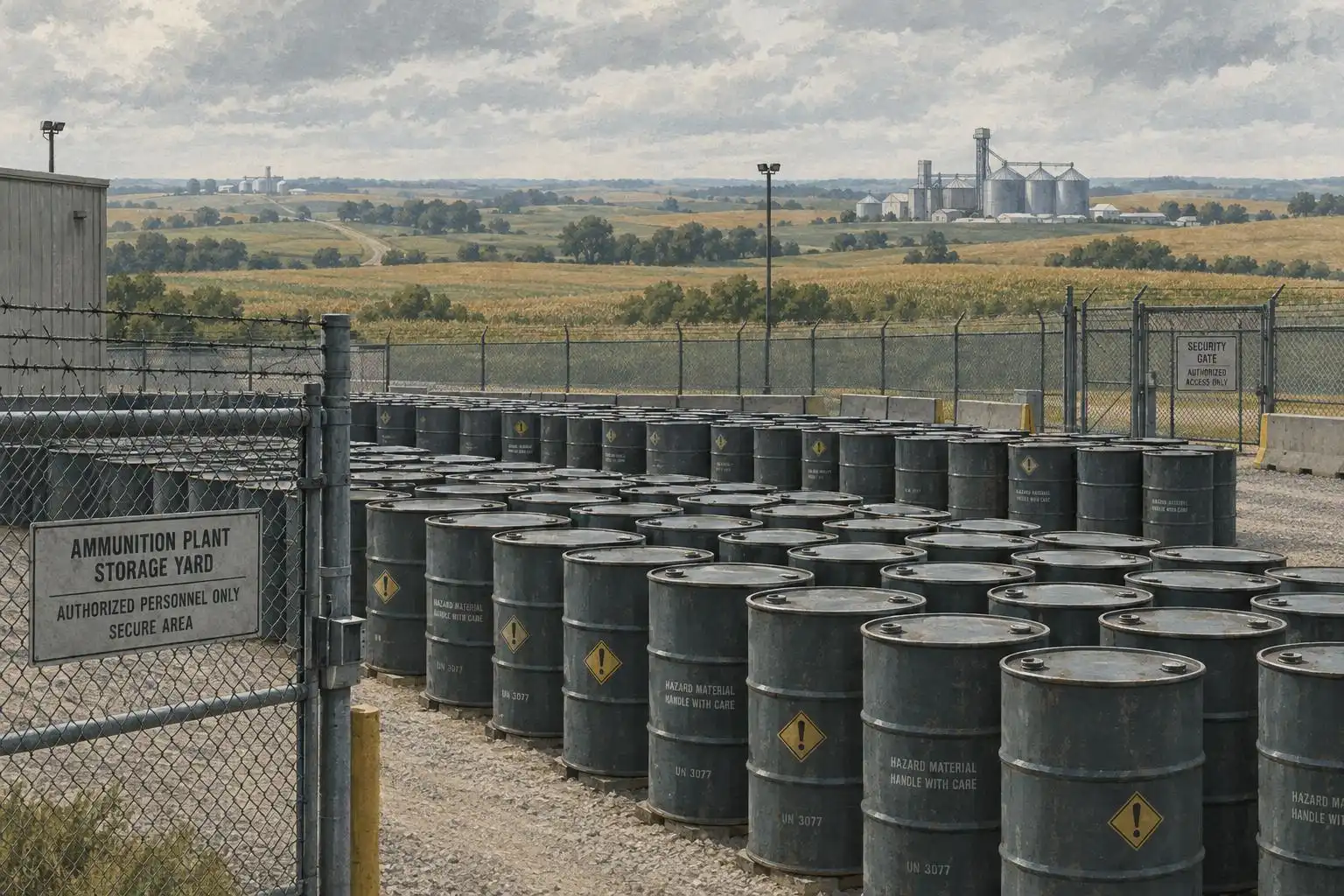

An Army plan to destroy unstable explosives in Iowa is drawing urgent questions about the safety of nearby communities. Abroad, military aircraft activity has put Japan and South Korea on alert, while Ukraine is struggling to expand the defense industry it needs to sustain its war effort.[3][1]
Iowa faces a difficult explosives decision
The U.S. Army plans a controlled detonation at the Iowa Army Ammunition Plant in Middletown at about 9 a.m. local time Wednesday. The operation would destroy nearly 70 drums holding almost five tons of material containing lead azide, a compound used to initiate munitions explosions.[3]

Army officials say the long-stored material has degraded and that its crystals could trigger an uncontrolled explosion if disturbed. They argue that colder weather increases the danger and that opening the containers to neutralize the contents would also be hazardous. Environmental groups, meanwhile, warn that the blast could spread toxic lead dust over parts of rural Iowa and northeastern Missouri.[3]
A federal court had delayed the blast over concerns about lead exposure, but a federal appeals court reinstated its permit Monday. That leaves officials and residents weighing two different risks: an aging stockpile that authorities say cannot safely remain in place, and the potential contamination from destroying it.[3]
Washington weighs trade and security moves
Higher U.S. levies aimed at excess industrial capacity overseas are expected this week, according to The Wall Street Journal. The report does not establish what the final measures will cover, but it points to another possible change in trade policy for businesses already navigating tariff uncertainty.[2]
Separately, the CIA and the Office of the Director of National Intelligence say some open-source and unclassified systems were exposed in a hack. The reported exposure concerns those systems; the available account does not say classified networks were breached.[2]
Asian airspace incidents prompt fighter scrambles
Military aircraft have skirted or entered the airspace of U.S. allies in Asia several times in recent days, prompting Japan and South Korea to scramble fighters, the Journal reports. The incidents add to regional tensions, though the account provided does not identify every aircraft or establish that each entered sovereign airspace.[1]
In the Pacific, the Solomon Islands says it will not allow foreign military bases on its territory. The statement addresses concerns that its ties with China could eventually lead to a Chinese outpost, without settling broader questions about the two countries’ relationship.[1]
Ukraine’s industrial challenge persists
Kyiv is trying to build out its revived defense industry under Russian bombardment and with an acute need for capital. The challenge is not simply to produce more equipment: factories and investors must operate amid continuing attacks. For Ukraine, expanding domestic production remains a pressing goal, but the conditions for doing so are exceptionally difficult.[1]
References
- Print Edition | Wall Street Journal — World — https://www.wsj.com/print-edition/20261125/world
- Print Edition | Wall Street Journal — U.S. — https://www.wsj.com/print-edition/20261125/us
- Live updates: Army prepares to detonate lead azide in Iowa | CNN — https://www.cnn.com/2026/11/25/us/live-news/iowa-lead-azide-detonation


Leave a Reply
You must be logged in to post a comment.