
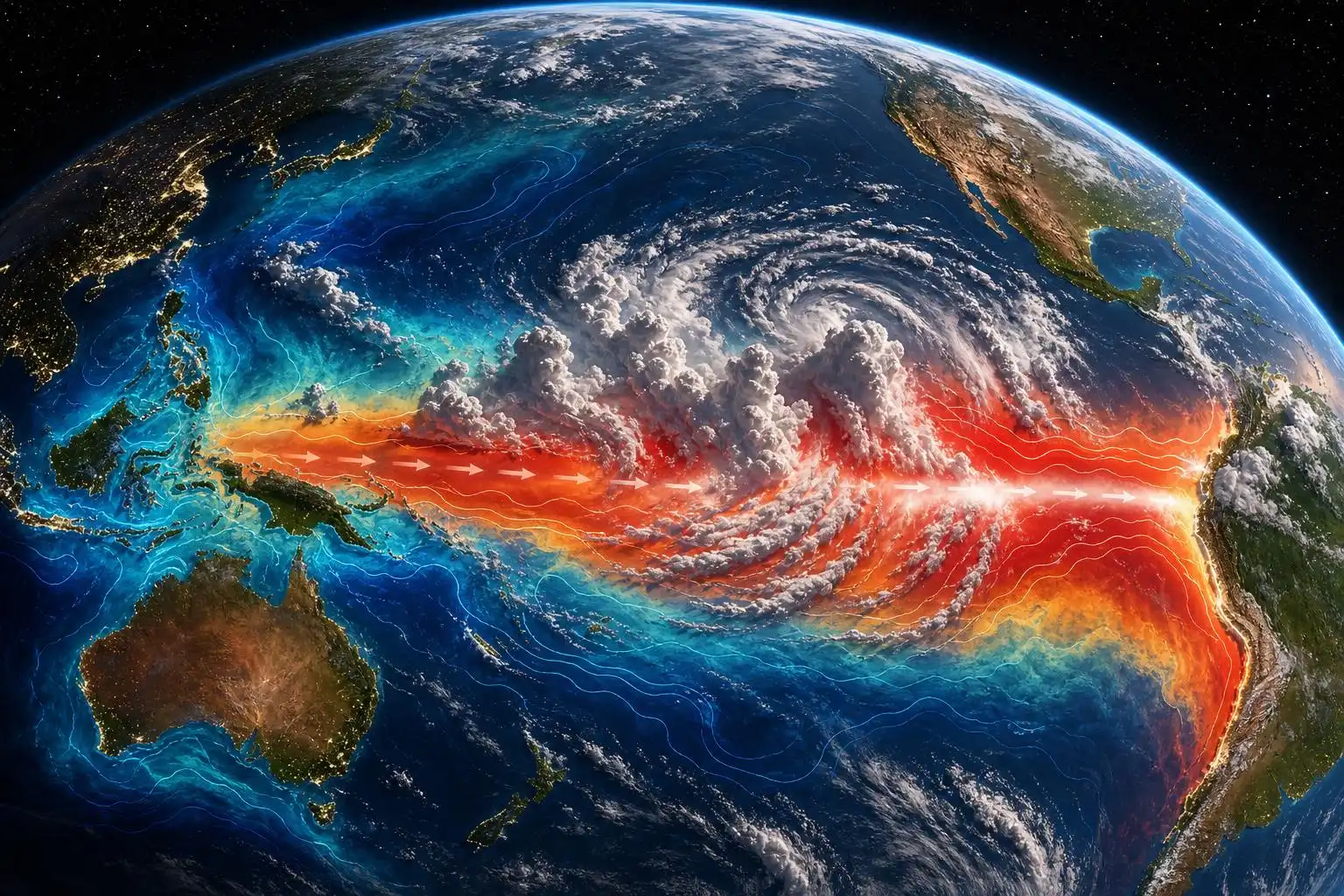

NOAA’s confirmation that El Niño has formed in the equatorial Pacific is more than a seasonal forecast update. It is a signal that one of Earth’s most powerful climate patterns is now interacting with a planet already running hot. According to NOAA’s outlook, there is a 63% chance this event strengthens by late fall and early winter into one of the largest El Niños in the historical record dating back to 1950 [1].
That matters because El Niño does not create weather in a simple, one-place-at-a-time way. It shifts the location of tropical thunderstorm activity across the Pacific, alters the jet stream, changes storm tracks, and redistributes heat and moisture across continents. In a cooler climate, that would still be disruptive. In today’s climate, where ocean and air temperatures are already elevated, El Niño can act like a boost button for extremes: heavier downpours in some places, deeper drought in others, stronger heat waves, elevated wildfire danger, and costly strain on agriculture and public health.
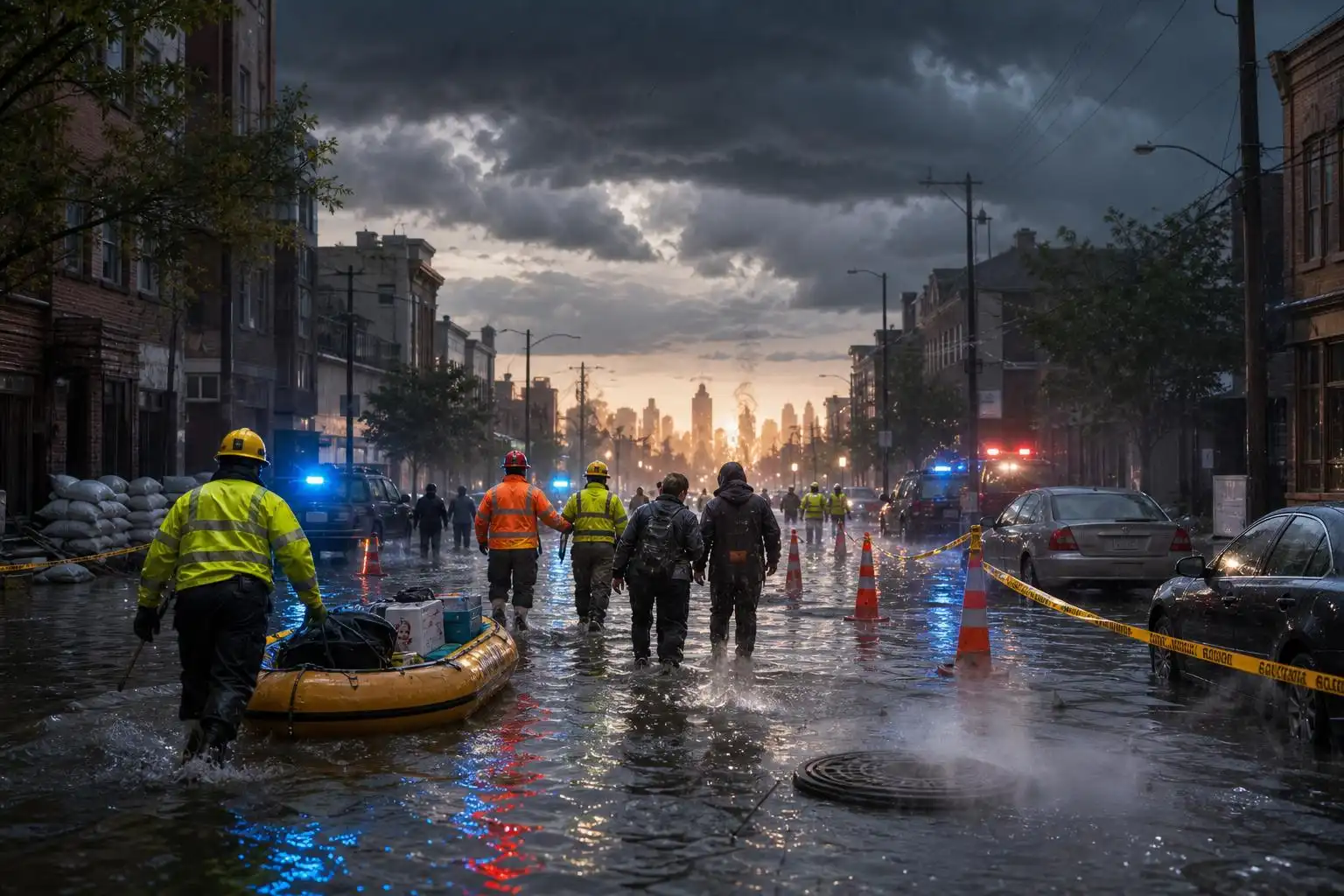
Climate scientist Abby Frazier described the warm, deep waters of El Niño as bringing “a lot of extra heat to the surface,” helping fuel extreme events in many parts of the world [1]. That is the key meteorological point: El Niño is natural, but it is unfolding on top of human-driven warming. The baseline has changed.
Why this El Niño could be especially disruptive
During El Niño, unusually warm water spreads across the central and eastern tropical Pacific. That warmth reorganizes tropical convection — the towering storm clusters that act like heat engines in the atmosphere. Once those storm clusters shift, they send wave patterns through the atmosphere that can influence weather thousands of miles away.
The Associated Press reported that meteorologists expect this El Niño could rival — or possibly exceed — the historic 1997 event, which was associated with billions of dollars in damage from heat waves, floods, droughts, tornadoes, and wildfires [4]. No two El Niños are identical, but the comparison is sobering. The 1997–98 El Niño remains one of the benchmark events forecasters use when discussing global disruption.
The concern is not only the ocean temperature anomaly itself. It is the timing and the background conditions. We already have widespread heat stress, persistent drought zones, vulnerable water supplies, and communities still recovering from recent storms and fires. When El Niño arrives in that environment, the impacts can stack up quickly.
The U.S. pattern: wetter South, warmer Northwest, and agricultural tradeoffs
In the United States, El Niño often tilts the winter pattern toward wetter conditions across parts of the South, including the Gulf Coast and Southeast, while the Pacific Northwest can trend warmer and drier. The strongest U.S. impacts often show up in winter, but the developing pattern can matter earlier as the atmosphere begins responding to tropical Pacific warmth.
NOAA’s Climate Prediction Center has noted that El Niño can bring more intense storms with heavier rainfall in the southern U.S., while sometimes benefiting broad parts of American agriculture [1]. That agricultural piece is complicated. Favorable moisture and temperatures can help grains and soybeans in major growing states, but dairy and cattle operations may face a more mixed outlook depending on heat, feed costs, water availability, and pasture conditions [4].
There is also a wild card in the West. Parts of the northern Rockies and Southwest have been dealing with an “off the charts” snow drought, and forecasters have suggested that stronger summer rains could help some areas [1]. But rain after drought is not automatically good news. Hard, dry soils can shed water quickly. Burn scars can turn moderate rainfall into debris flows. Desert washes can become dangerous in minutes. If El Niño moisture arrives in bursts rather than gentle, soaking events, flash flooding can become a major hazard.
Global pressure points: floods, drought, fires, and heat
The clearest El Niño impacts often appear around the Pacific Rim and across the tropics. Western South America, where the phenomenon was first recognized by coastal communities, can see heavy rain, flooding, and unusually warm conditions. Australia often faces heightened drought, heat, and wildfire risk. India can experience more intense heat waves. In the Middle East, where drought has been severe, El Niño-related shifts may bring some relief in certain areas, though rainfall distribution is never guaranteed [1].
Northeastern Africa is one of the regions forecasters are watching closely. Columbia University climate scientist Muhammad Azhar Ehsan warned of possible “weather whiplash” there, with areas shifting from intense drought toward dangerously heavy rains [4]. That kind of swing can be devastating. Drought weakens crops, livestock, water systems, and household finances. Then flooding can destroy what remains — roads, homes, seed stores, clinics, and schools.
We are already seeing reminders of how quickly weather can disrupt daily life. Reuters reported strong winds and waves pounding Wellington, New Zealand, canceling flights and ferries [5]. One stormy episode does not define an El Niño, but it fits the broader reality: when ocean-atmosphere patterns become more energized, transportation, coastal infrastructure, and emergency services are often among the first systems tested.
Heat is the quiet disaster inside the larger climate story
El Niño years are often globally warm years, and that is where the public health concern becomes especially serious. Extreme heat already kills more people in the U.S. each year than all other extreme weather hazards combined, and heat-related deaths have surged by more than 50% over the past two decades [2].
A new study published in GeoHealth found that extreme heat could nearly double U.S. hospitalizations by 2040, pushing annual healthcare costs for heat-related conditions above $1 billion [2]. The burden will not be evenly shared. California and the Las Vegas area are expected to see large numbers of heat-related health problems, while regions less accustomed to dangerous heat — including the Northeast and Ohio Valley — may suffer severe consequences during major heat events [2].
From a meteorologist’s perspective, this is one of the most important messages to communicate: heat risk is not just about the afternoon high temperature. It is about overnight lows, humidity, access to cooling, housing quality, job exposure, medication use, age, and pre-existing health conditions. A 96-degree day with high humidity and a nighttime low near 80 can be more dangerous than a hotter but drier day if the body never gets a chance to recover.
Climate shocks are also human displacement shocks
Extreme weather does not stop at the edge of a flooded field or burned neighborhood. It can push people across borders. Recent reporting on temporary protected status noted that Syrians, Ethiopians, and Haitians in the U.S. are among those connected to countries facing severe drought, flooding, falling agricultural production, and repeated climate shocks [3].
This is an often-overlooked part of the El Niño conversation. When drought reduces harvests, when floods wipe out roads, when heat makes outdoor labor unsafe, and when storms damage fragile housing, migration pressure rises. Climate does not act alone — conflict, poverty, governance, and infrastructure all matter — but weather extremes can be the final shove for families already living close to the edge.
What communities should do now
A potentially strong El Niño is not a reason for panic, but it is a reason to prepare early.
For flood-prone communities, that means clearing storm drains, reviewing evacuation routes, checking flood insurance status, and paying attention to burn scars and low-water crossings. For households, it means keeping emergency alerts enabled and never driving through flooded roads.
For heat-vulnerable neighborhoods, preparation means identifying cooling centers before the first major heat wave, checking on elderly neighbors, creating workplace heat plans, and making sure people know the symptoms of heat exhaustion and heat stroke. Heat stroke is a medical emergency: confusion, fainting, hot skin, and a very high body temperature require immediate help.
For farmers and ranchers, this is a season to watch soil moisture, water availability, livestock heat stress, and disease pressure carefully. El Niño may help some crops in some regions, but it can also bring volatility.
The atmosphere is entering a period where the odds of costly extremes are rising. El Niño is not the only driver, but it is a powerful one. The science gives us enough warning to act before the worst impacts arrive. That preparation — from forecast offices to hospitals, farms, ports, and family homes — may determine how much damage this event ultimately does.
References
[1] El Niño forms in Pacific as experts say it will likely turbocharge extreme weather – The Guardian
[3] Trump targeting immigrants from countries hit most by climate shocks – The Guardian
[5] Strong winds, waves pound Wellington, canceling flights and ferries – Reuters

Leave a Reply