
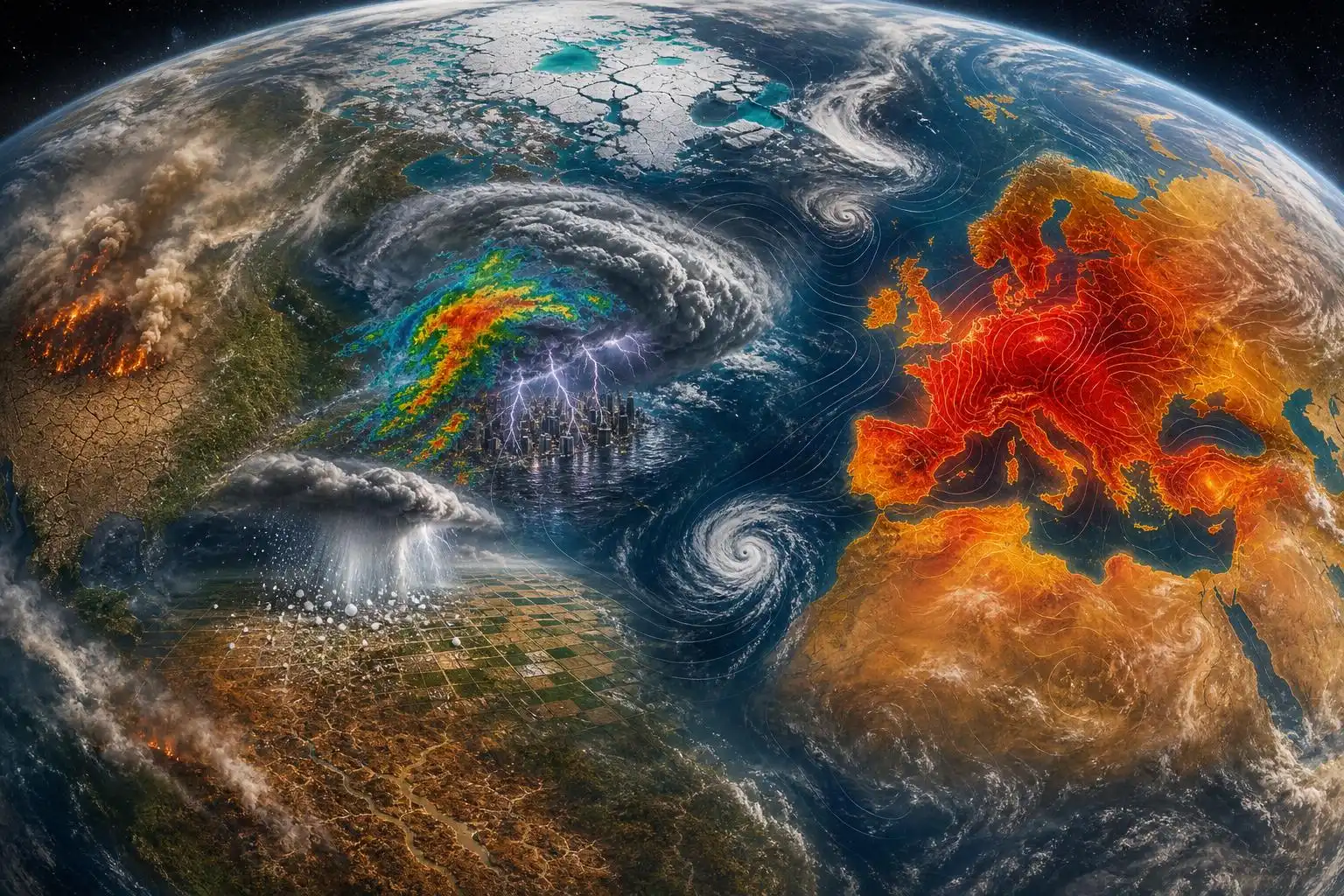

The latest global climate outlook is not subtle: the atmosphere is entering a high-risk stretch where record heat, heavier rainfall bursts, earlier-season heat waves, drought stress, wildfire danger, and more destructive hail all become more likely at the same time.
The World Meteorological Organization’s new five-year projection warns that Earth is overwhelmingly likely to exceed the 1.5°C benchmark above pre-industrial levels in at least one year before 2030, with a strong chance that a new hottest year will be set during that window [1]. That does not mean the Paris Agreement’s long-term 1.5°C target is officially breached in the same way scientists assess climate goals over multi-decade averages. But it does mean we are living through more frequent previews of what a warmer baseline climate can do.
And those previews are already showing up in the weather map.
A hotter baseline loads the dice
One of the most important pieces of the WMO outlook is the role of El Niño. Forecasters now see a high probability of El Niño conditions developing by late 2026 into early 2027, with some forecasts allowing for a stronger event. El Niño releases ocean-stored heat from the tropical Pacific into the atmosphere, often helping push global temperatures upward. According to reporting on the WMO assessment, 2027 is a leading candidate to break the current global heat record if that El Niño matures as expected [2].
That matters because global warming is not just about the number on a thermometer. A warmer atmosphere can hold more water vapor, roughly 7% more for every 1°C of warming. That extra moisture can intensify downpours when storms have enough lift and instability. At the same time, higher temperatures increase evaporation from soils and vegetation, worsening drought and wildfire risk where rain does not arrive.
So the same warming trend can support both extremes: flash flooding in one region and severe drought in another.
New York’s flash flooding shows the infrastructure problem
New York City offered a sharp example of how intense rainfall can overwhelm older drainage systems. Large parts of Brooklyn and Queens recently received around 2 inches of rain in as little as 20 minutes, sending water into the sewer system at rates far above what the network was designed to handle [3]. Streets turned into fast-moving channels, subway service was disrupted, roads were blocked, and power outages followed as storms pushed through the region.
This is where climate science meets city planning. Many urban drainage systems were built using historical rainfall statistics that no longer fully describe today’s risk. When rainfall comes down too quickly, even a storm that is not tropical in origin can produce dangerous flash flooding.
For residents, the safety message is simple but urgent: never walk or drive through moving floodwater. Six inches of fast-moving water can knock an adult off balance, and a foot or two can float or sweep away many vehicles. In a city environment, floodwater can also hide open manholes, electrical hazards, debris, and contaminated runoff.
Europe’s early heat is a warning sign
Meanwhile, western Europe has been dealing with an unusually early heat dome, with parts of the United Kingdom, France, and Germany running 10–15°C above average for late May [3]. France placed numerous departments, including Paris, under heat alerts, and authorities reported deaths directly and indirectly connected to the extreme temperatures, including drownings as people sought relief in water [4].
Early-season heat is especially dangerous because people are often not acclimated yet. Homes, schools, and workplaces may not be prepared. Outdoor events may not have summer-level heat protocols in place. And in parts of Europe where air conditioning is less common than in the United States, nighttime temperatures can become a major health threat when buildings fail to cool down.
Heat safety is not complicated, but it has to be taken seriously:
- Check on older adults, people with chronic illness, infants, and those without reliable cooling.
- Avoid strenuous outdoor activity during the hottest part of the day.
- Drink water before you feel thirsty, and replace salts if sweating heavily.
- Never leave children, pets, or vulnerable adults in parked vehicles.
- Treat confusion, fainting, hot dry skin, or loss of consciousness as a medical emergency.
As a meteorologist, I pay close attention to warm nights during heat waves. Daytime highs get the headlines, but high overnight lows prevent the body from recovering. That is often when heat becomes deadliest.
The Arctic and Amazon are two regions to watch
The WMO outlook also highlights two major climate pressure points: the Arctic and the Amazon. The Arctic is expected to warm much faster than the global average, with projections pointing to unusually warm winters through the end of the decade [1]. That has consequences well beyond polar communities, including sea ice loss, permafrost thaw, ecosystem disruption, and possible changes in atmospheric circulation patterns.
The Amazon, meanwhile, is projected to lean drier, raising concern for drought and wildfire risk [1]. That is especially concerning because the Amazon is one of Earth’s most important natural carbon stores. Severe drought and fire can weaken that carbon sink and add more carbon pollution back into the atmosphere.
In other words, climate extremes are not isolated events. They can feed back into the larger system.
Bigger hail is another costly signal
A new study published in Nature adds another piece to the extreme-weather puzzle: hail. Researchers found that a warmer world is likely to produce fewer small-hail events in some places but more storms capable of dropping larger, more damaging hailstones [5].
The physics makes sense. Hail needs strong thunderstorm updrafts, supercooled water, and enough instability to keep growing stones suspended in the storm. A warmer atmosphere can increase instability and storm energy when moisture and wind patterns line up. The study suggests hail larger than a large marble could increase substantially by late century, with Argentina, Europe, Canada, and the U.S. Northern Plains among areas facing some of the biggest increases [5].
Hail is often underestimated because it usually does not produce the same fatality counts as tornadoes, floods, or heat waves. But it is enormously expensive. In the United States alone, hail already causes billions of dollars in annual damage to roofs, vehicles, crops, solar farms, and infrastructure.
For homeowners and communities, this points to a practical adaptation challenge: stronger roofing materials, better vehicle shelter options, crop protection strategies, and more hail-aware building codes in vulnerable regions.
The human side of a hotter, rougher atmosphere
The phrase “record heat” can sound abstract until it shows up as a flooded subway platform, a heat-stressed apartment, a ruined crop field, a wildfire evacuation, or a roof shredded by baseball-size hail. That is the through-line in these recent reports: the atmosphere is not changing in one neat way. It is amplifying the kinds of weather hazards that communities already struggle to manage.
The next five years will test forecasting systems, emergency managers, infrastructure, agriculture, public health agencies, insurers, and households. Better forecasts will help, but forecasts alone are not enough. Cities need drainage systems designed for heavier rainfall bursts. Heat plans need to account for earlier and longer warm seasons. Wildfire planning must include drought-prone regions that historically had less fire exposure. And severe storm preparedness must include hail as a major financial and safety risk.
We cannot prevent every weather disaster. But we can reduce the damage when we take the science seriously before the warning is issued.
References
[1] Think it’s hot now? The next five years will smash records, UN says – AP News
[2] World almost certain to endure record hot year by 2030, UN warns – The Guardian
[3] Weather tracker: flash floods in New York and a heat dome in Europe – The Guardian
[4] Extreme heat in Europe ‘a brutal reminder’ of climate crisis, UN chief says – The Guardian
[5] A warmer world creates bigger and more damaging hailstones, study says – AP News

Leave a Reply