


The Fourth of July weekend is arriving with the kind of heat that changes how a holiday feels on the ground. Parades, fireworks, outdoor concerts, soccer matches, and family cookouts are all being forced to share the stage with a sprawling heat dome over the central and eastern United States. In Washington, D.C., Philadelphia, New York, and other major cities, the combination of high temperatures and oppressive humidity is pushing heat index values into dangerous territory, with forecasts suggesting it could feel as hot as 115°F in parts of the urban corridor.[3]
This is not just a hot holiday weekend. It is a public-safety event.
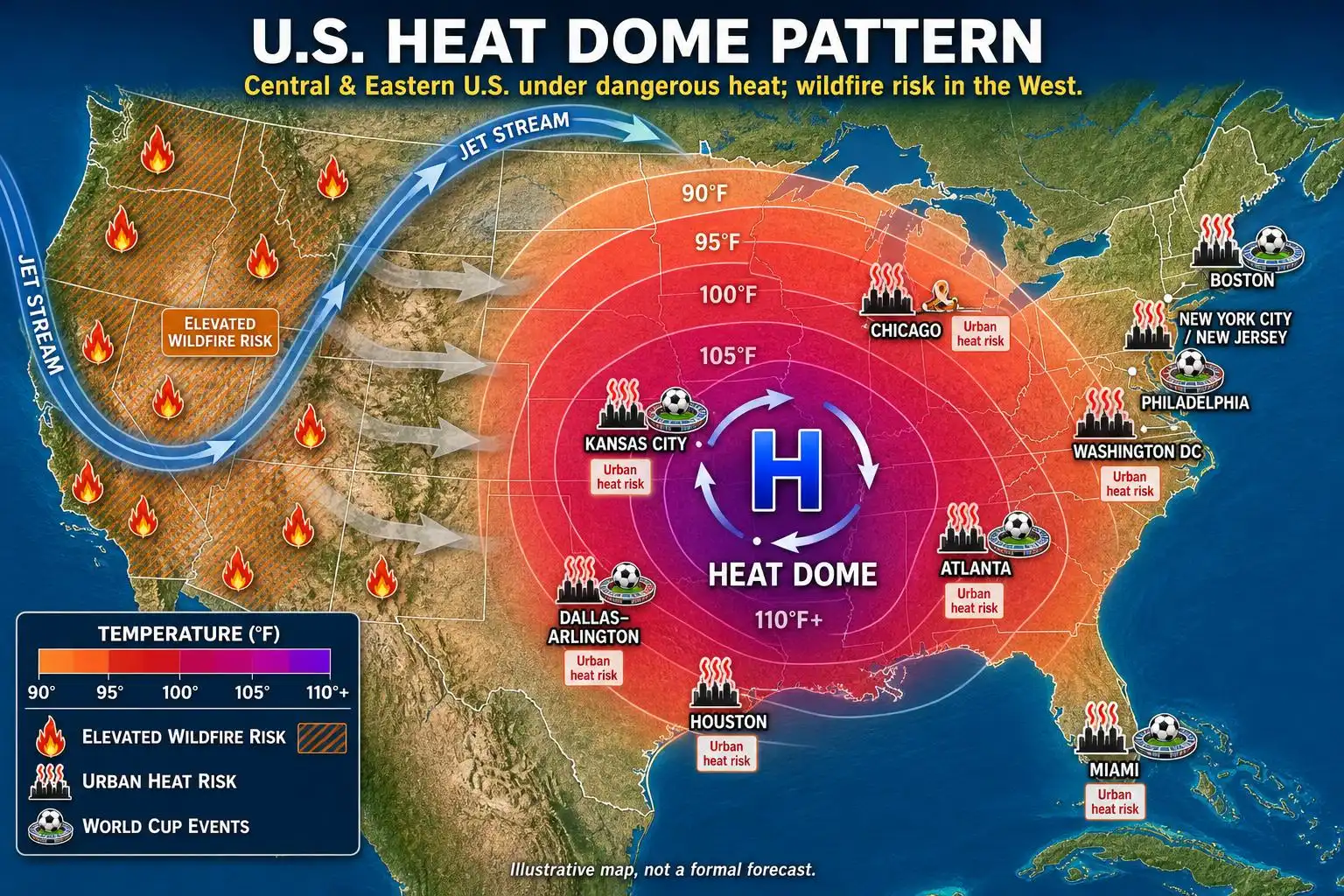
A heat dome forms when a strong area of high pressure parks over a region and suppresses rising air. That sinking air warms as it compresses, skies tend to stay clearer, and surface heat builds day after day. When humidity is also high, the body’s main cooling mechanism—sweating—becomes less efficient because evaporation slows down. That is why a 96°F afternoon in muggy air can feel much more dangerous than the thermometer alone suggests.
The National Weather Service has warned that this type of rare, long-duration heat, especially with little overnight relief, can affect anyone without reliable cooling or adequate hydration.[3] That last phrase matters. Heat risk does not end at sunset. When nighttime lows stay near or above 80°F in densely populated cities, apartments, row homes, and upper floors may never cool enough for the body to recover. Sleep becomes difficult, dehydration worsens, and vulnerable people—older adults, outdoor workers, people with chronic illness, young children, and those without air conditioning—face escalating risk.
The timing makes this heat especially concerning. Millions are expected to gather outdoors for Independence Day events, including celebrations tied to the nation’s 250th anniversary. In Washington, public access to a July 4 concert rehearsal was restricted because of excessive heat concerns, according to reporting from the BBC.[3] Meanwhile, World Cup matches are being played in some of the same heat-stressed cities. The Guardian reported that France’s match against Paraguay in Philadelphia was expected to face extreme heat levels that a global players’ union has previously said should trigger delay or postponement discussions, while a Miami match between Cape Verde and Argentina also faced potentially dangerous heat and humidity.[1]
Athletes are not immune to heat simply because they are fit. In fact, elite soccer can create a perfect setup for heat stress: high metabolic output, limited shade, sun-heated playing surfaces, and repeated bursts of exertion. Add humidity, and the margin for safe cooling narrows quickly. For spectators, the risk can be even more uneven. A healthy fan with water and shade may cope; someone sitting in direct sun, standing in security lines, drinking alcohol, or traveling with children may run into trouble much faster.
The science behind this event is also becoming clearer. World Weather Attribution researchers found that the scorching heat affecting much of the U.S. this week would have been “virtually impossible” without human-caused climate change, according to The Guardian’s summary of the analysis.[1] The same analysis described the current event as rare even in today’s climate—roughly a 1-in-200-year heatwave—but one that would not have been expected even once in many thousands of years without the roughly 1.4°C of global warming already added to the climate system.[1]
That does not mean every hot day is caused only by climate change. Weather still has its own day-to-day mechanics: ridges of high pressure, soil moisture, jet stream placement, and local winds all matter. But climate change loads the dice. It raises the baseline temperature from which heatwaves begin, increases the odds of record-breaking extremes, and makes nighttime heat more punishing—especially in cities where concrete, asphalt, and buildings store heat after sunset.
The impacts are already visible. Reuters reported that record-breaking temperatures sent residents in cities such as New York and Atlanta searching for relief at cooling centers ahead of the holiday weekend.[4] Cooling centers can be lifesaving, but they work best when people know where they are, can reach them safely, and feel welcome using them. That is why heat emergencies are as much a communication challenge as a meteorological one.
The heat is not limited to the eastern half of the continent. In the West, hot, dry, and windy conditions have raised wildfire danger across parts of the Great Basin and Southwest, while fires have been active in Utah, Colorado, Arizona, and surrounding areas.[2] The Guardian reported that three firefighters working for U.S. wildland and forest service agencies were killed near the Colorado-Utah border and two others were injured when they were overcome by flames from fast-moving wildfires.[2] That tragedy is a stark reminder that heat and fire weather often overlap. Dry vegetation, gusty winds, low humidity, and extreme temperatures can turn an ignition into a rapidly moving threat.
This U.S. heatwave is also part of a broader Northern Hemisphere pattern. Europe has been dealing with dangerous early-summer heat as well. France recorded 2,025 excess deaths during the peak of a recent heatwave, according to the BBC, while additional heat was forecast to build again from Portugal and Spain toward France and southern Britain.[5] Those numbers underline a difficult truth: heat is often quieter than hurricanes, tornadoes, or flash floods, but it is one of the deadliest weather hazards we face.
For anyone attending outdoor events this weekend, the safety advice is straightforward but important:
- Check the heat index, not just the air temperature.
- Hydrate before you feel thirsty, and take water with you if allowed.
- Avoid alcohol-heavy hydration strategies; alcohol can worsen dehydration.
- Seek shade or air conditioning during the hottest part of the day.
- Wear light-colored, loose-fitting clothing and use sunscreen.
- Never leave children, older adults, or pets in parked vehicles.
- Learn the signs of heat exhaustion: heavy sweating, dizziness, nausea, weakness, headache, and clammy skin.
- Treat possible heat stroke as an emergency: confusion, fainting, very high body temperature, or hot dry skin requires immediate medical help.
Communities also have a role to play. Event organizers should expand shade, water access, medical staffing, misting areas, and cooling shelters. Sports leagues should use wet-bulb globe temperature or similar heat-stress metrics—not just air temperature—when deciding whether to delay, modify, or postpone play. Cities should communicate cooling center locations clearly and repeatedly, especially in neighborhoods with limited tree canopy and lower air-conditioning access.
As a meteorologist, I often say that heat is a cumulative hazard. One hot afternoon can be dangerous, but several hot days and warm nights in a row become something more serious. The body loses its recovery window. Infrastructure strains. Emergency rooms see more heat illness. Power demand rises. Fire weather worsens in dry regions. Outdoor workers and unsheltered people face the conditions hour after hour.
This holiday weekend is a celebration of American history, but it is also a preview of the climate conditions that increasingly shape modern life. The weather pattern will eventually break. The larger signal will not. Planning for heat—at ballfields, construction sites, schools, stadiums, transit stops, and city neighborhoods—is no longer optional. It is becoming one of the central safety challenges of summer.
References
- US heatwave threatens 250th anniversary events and World Cup — https://www.theguardian.com/us-news/2026/jul/03/heatwave-world-cup-250th-anniversary
- Heatwave and high humidity to blast much of US: ‘impactful to anyone’ — https://www.theguardian.com/us-news/2026/jun/28/heatwave-humidity-fourth-of-july-weather
- Dangerous US heatwave looms over 4 July holiday, World Cup and Swift wedding — https://www.bbc.com/news/articles/cevlkzer7vdo
- Extreme heat grips much of the US ahead of the July 4 weekend — https://www.reuters.com/video/watch/idRW433302072026RP1/
- France records 2,025 excess deaths at peak of heatwave as Europe braces for more extreme weather — https://www.bbc.com/news/articles/c3ry307rxqro


Leave a Reply
You must be logged in to post a comment.